
Lincolnshire's planning for WWII invasion
Recently, at Market Rasen Rotary David Hunter was introduced by Rtn. Peter Robinson. David spoke on The organisation of resistance in Britian during WW2 and the part played by Lincolnshire in this ‘Secret Army’
David is a volunteer in the Coleshill Auxiliary Research Team which maintains the British Resistance Archive website, and an active researcher of the history of WW2.
He began by explaining that when Churchill realised in 1940 that Hitler was preparing to invade England he approved the setting up of Auxiliary Units, which eventually became known as Churchill’s Secret Army. The whole operation was kept secret and few people even knew of its existence. Rtn. Peter Robinson’s father was a Sergent and Patrol Commander for the Swallow patrol in the organisation. Britian was preparing for invasion as it was clear that Nazi Germany was moving quickly through one European country after another. Britian had sent its Army into France to try and stop any further advance. In the event this failed and most of our Army ended up stranded near Dunkirk.
The Secret Army was a sabotage organisation which was set up in case of a Nazi invasion of the UK. We were unusual in this regard, as this resistance setup was established well before any invasion had taken place. In England the HQ for this group was setup in Coleshill House on a large country estate in which now lies on the Oxfordshire / Wiltshire border (during the war it was in Berkshire, but the county boundaries were changed in the 1970’s). Coleshill House also housed the Special Duties Branch (secret civilian spy network), Intelligence Officers of the Scout Sections, and links to the Special Air Services (SAS) and the Special Operations Executive (SOE). These often carried out missions in Occupied Europe with men recruited directly from the Auxiliary Units.

David explained that these Auxiliary Units were eventually spread all along our coastline, places where any invasion was likely to occur. They recruited civilians such as local farmers, foresters, gamekeepers, farm workers, etc. people who had intimate local knowledge of their surroundings and the rural area with recruits coming from those with reserved occupation status, all used to handling guns and explosives and their local knowledge, fields, hedgerows, woodlands, railway lines, helpful to hinder any enemy advance.
In the beginning local candidates for the Secret Army were chosen from existing enlisted officers and soldiers from the regular army. This ‘starter’ group were sent down to Coleshill for the specialised training thought to be necessary for this new guerilla role. After training they were sent back to their local areas to set about recruiting from the local population to set up a network of cells which would eventually become Britian’s last line of defence. Separately, even before war broke out there were local groups of Defence Volunteers and these eventually became the Home Guard. Some members of these organisations were recruited for this new role.
This secret underground resistance had specialised training in sabotage and guerilla warfare. Their main task was that in the event of an invasion they would attempt to slow everything down to give Britian time to regroup to fight the invaders. The general rule would be to remain invisible – after an invasion, if you were seen, you most likely would be killed.
Each cell first had to set up Operational Bases (OB) which would be underground and hidden from view. Together with theses bases would be additional hidden Observation Posts. The idea was that these OB’s would house 6 or more people who would train and prepare for invasion. They would also collect information and relay it back to central command posts so that Army HQ would know what was happening. Initially this would be done by members taking written messages to hidden ‘drop boxes’, collecting anything there take back and returning to base.
There was a network of these ‘runners’, who would never meet each other but would eventually ensure that messages got transmitted. This was a very slow and inefficient process and was quickly replaced by an improved specialised radio system.
The organisation for Lincolnshire was, eventually, headquartered in Dalby Hall near to Spilsby. This came under the Area 2 Headquarters based North Bar Within, Beverly. This office was located over a Sweet Shop and Tobacconists and the Intelligence Officer there for the Lincolnshire area was Captain William Melville Beattie Lamb.
Training of all members of this Army was a very important aspect. The Brocklesby Estate was an important training location for the North Lincolnshire area. The initial officers that had been trained at Coleshill now were passing on their skills to each of the Operational Bases in their area. Many of the members were already good shots but now they would be trained as snipers, and to cause as much damage as possible to any enemy facilities.
Caistor had its own OB and this was based at Hundon Manor on land then owned by local dentist Mr. Jackson. When the base was completed, it was used for storing ammunition, machine guns and general supplies as well as being the operation base of the group.
This base was under the command of Sergeant George Herring who had been asked to form and lead the group because of his previous experience in WWI.
Swallow was another location chosen for an OB and this one was in a wooded area to the east of Swallow Wold Farm. This base has been located and found to be in remarkably good condition. The entrance and escape hatches were found to have been very well hidden and disguised in the woodland. Of interest, the Sergeant in charge of this group was Henry Robinson, father of Rtn. Peter.
The secret nature of this Army did mean that the population knew very little about it and if they did there was no obvious means to contact it. The one contact that existed for this Secret Army was the local Post Office at Highworth, close to Coleshill. Mabel Stranks was the Post Mistress from 1927 and was responsible for counter services, postal delivery service and the telephone switchboard. Mabel became the Gateway to the Coleshill operation – an extra layer of security necessary to maintain the secrecy of Coleshill.
Highworth Station was at the end of a branch line from Swindon and only 3 miles from Coleshill. This post office was a perfect ‘go-between’ with strangers visiting all the time and with a Post Mistress known for her unassuming nature and discretion. The official address of this Auxiliary Gateway became GHQ Auxiliary Units, c/o General Post Office, Highworth, Wiltshire. It became the first port of call for all personnel visiting the Coleshill HQ. People would arrive at the post office and ask for Mrs. Stranks and then request ‘3 half penny stamps but I only have half a crown’ Mabel would then retire to the office and phone Coleshill House and leave a message. These messages were apparently of two types, one where she said she was comfortable with him, or the other where she suspected that there was something not quite right. Transport would then be sent from Coleshill and this was the end of Mabel’s involvement. Those that were ‘screened’ as OK by Mabel would then be met by a car and then driven by the most indirect route to Coleshill House. Mabel lived in Highworth until her death in 1971 at 88 years old.
In the event of an invasion members of each OB unit would essentially ‘go to ground’ and prepare to put their training into action and try to defend the country. Most of the local population, wives, children etc would have no idea of where their menfolk had gone and would have no idea that they may never see them alive again. Soon after the start of the war all church bell ringing was suspended – bells only to be rung again to warn that the invasion had started. Bonfires and church bells were not to be heard again until VE day. Women were not involved in this organisation however, they were in the Special Duties Branch, which was used by the Intelligence agencies to collect and pass on messages and information. Here, manning was mainly by civilians, the Royal Signals or the ATS (Auxiliary Territorial Service – the women’s branch of the British Army).
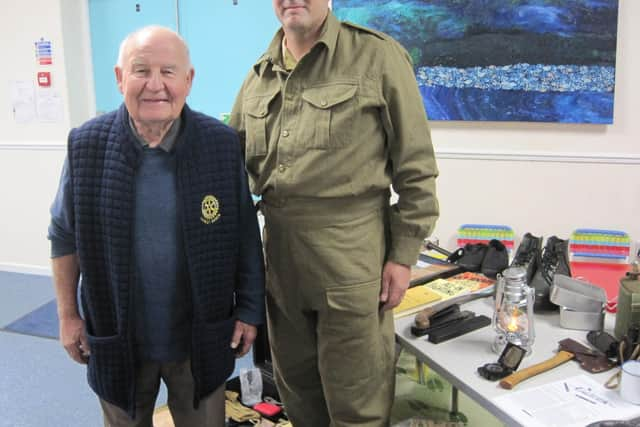
David brought a large number of artifacts collected over the years from these Auxiliary units and he was able to display maps and operational instructions, various weapons such as fighting knives, pistols, rifles and machine guns. Instruction manuals for explosives and demolitions were made to appear as common fertilizer catalogues so that if they were left on a table or shelf, nothing would appear suspicious. The display included types of explosive devices, grenades and such like and the type of ammunition that would have been used. He also gave us some gruesome demonstrations on how some of these things would be used.
The Auxiliary Units were finally stood down in 1944 when it became clear that the danger of Nazi invasion had passed. As very well trained and experienced personnel many members moved down to the south and the Isle of Wight where they helped and supported the rapidly developing D-Day landings and the subsequent operations to liberate France. Some went into the SAS and were parachuted into France prior to D-Day to try and limit the capability of the German defence once the invasion began.
The Coleshill Auxiliary Research Team archive website has much interesting information about this topic: https://www.staybehinds.com/