
Play cafe celebrates planning appeal win over signage

The owner of a popular children’s play cafe is celebrating after winning her appeal to overturn a council ruling against the signage above her business,
Henna Karim-Sayer got the news from the government’s planning inspectors after a year-long battle with North Kesteven District Council’s planning department.
Council officials had ordered her to remove the tasteful, vinyl sign above The Bairns in Sleaford Market Place as it was deemed inappropriate for the conservation area, instead expecting her to spend hundreds of pounds on new wooden, hand painted signage.
Henna had got the keys to the premises in May last year, while heavily pregnant, giving birth just a few weeks later, but finally opening in August.
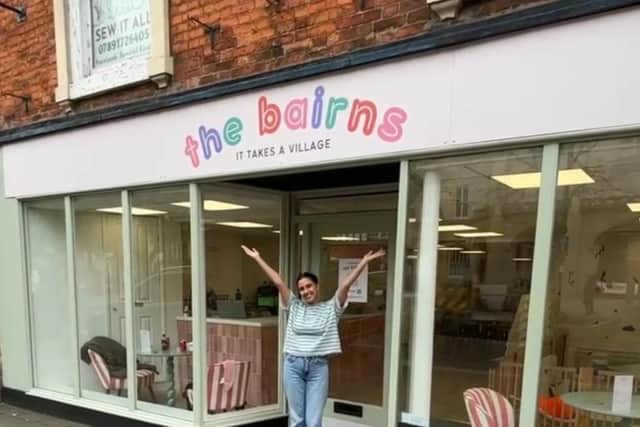

After much delay and negotiations with North Kesteven District Council planning and conservation officers she had to go ahead and open, therefore installing the vinyl sign, however she finally received news on September 12 that it had been refused permission, citing that the materials were inappropriate for the grade II listed building and conservation area based on new shop front design guidelines which were only in draft form with the council at the time she applied, but officers opted to enforce them.
The council also argued that she could have sought funding from its shopfront scheme, however, Henna explained that at the time she had just had her second baby and missed the deadline for applications and would have only been able to go on a reserve list.
A spokesperson for North Kesteven District Council had said at the time: “The property in question is a grade II listed building and as such the council wants to ensure the special character of the building, and the wider town centre, are preserved and enhanced.
“In this case, the applicant was advised early on about the need for advertisement consent and listed building consent. They were also made aware of the opportunity to apply for a shopfront grant, which would pay up to 90 per cent of the costs of a traditional hand-painted sign.
“This advice and opportunity for funding was given on more than one occasion. Despite being advised that the proposed signage would not be supported, the applicant proceeded to install the signage in question. The applicant has the right of appeal against the refusal of both listed building consent and advertisement consent.
“The North Kesteven Shopfront Design Guide has been produced, in part, to ensure the delivery of high-quality traditional signage within town and village centres, and conservation areas. The applicant was made aware of the guidance contained in the draft Design Guide through the planning process
“The document gives clear guidance of what is appropriate and how not following it can lead to applications being refused. It helps businesses to aspire for better signage within the town centre, enhancing the character and appearance of the town.”
Henna argued to replace it with a hand painted sign would be too costly (up to £1,000) and unfair for a fledgling business when neighbouring businesses had very similar signs to hers.
An online petition backing Henna’s campaign generated over 8,000 signatures.
Henna appealed against the decision in November and finally heard that she had won this month.
She said: “It’s taken hours of paperwork, lots of stress and endless conversations of ‘how are you getting on with your sign?’ but we’ve done it!
“I honestly thought it was a lost cause, but I’m glad to see the planning inspectorate have taken a common sense approach and granted us permission (for the next five years at least).
“Thank you so much to everyone that supported and offered help. The sign is here to stay!”
Commenting on the council’s concerns regarding the sign’s materials and colouring, Planning inspector Zoe Raygen had stated the sign fitted well into the existing shopfront: “The lettering does not overwhelm the sign, using a harmonious colour scheme.” She added that it had a matt finish and not lighting, making it harder to tell what it was made from, concluding “the sign is not intrusive, nor does it harm visual amenity”.
She noticed that neighbouring signs were of varying materials. Although a timber fascia would be preferable she felt the existing sign was not harmful to the listed building and in fact preserved the character of the conservation area, granting permission for the sign and the change of colour of the woodwork for a period of five years.