
Quick thinking and innovative fire prevention tech helped stop blaze that threatened thousands of acres


Farmers have praised the fire service and local community who sprang into action to help prevent a huge blaze on a farm that threatened thousands of acres of crops.
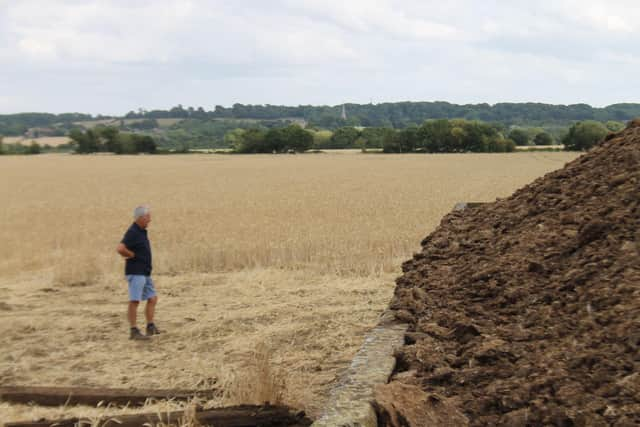
Andrew Ward and Rhonda Thompson, who are based at Leadenham, saw a manure heap heat up and spontaneously combust last weekend and with the ground tinder-dry feared the worst as the fire threatened wheat fields and the surrounding countryside.
This follows other countryside and farm fires across the county in recent weeks and the NFU is highlighting the increasing risk of wildfires on farmland and the need for action from government, fire services and local authorities to protect lives and livelihoods.
The National Fire Chiefs Council has reported more than 500 wildfires in 2025, while data from the NFU Mutual shows the increasing cost of farm fires, reaching £110 million in 2023 – an increase of 37 per cent from 2022.
Last week the NFU and Lincolnshire Fire and Rescue Service also reminded people about the devastating consequences of fires with the ground so dry and warned against those burning rubbish, discarding cigarettes, glass bottles or using disposal barbecues.
The fire on the farm at Leadenham was only contained due to the quick thinking of a neighbouring farmer who raised the alarm and farm staff and others worked quickly with firefighters to bring it under control using a special fire adapter that allows farm water supplies to be used by fire crews.
The adapter was developed by Louth Park Farms manager Ian Watson, which can be carried by the fire service and at businesses enabling them to connect to on-farm water sources such as bowsers and tankers.
Funding for the adapters for Lincolnshire Fire & Rescue Service was secured by Ms Thompson from the NFU, NFU Mutual, Anglian Water and the Environment Agency.
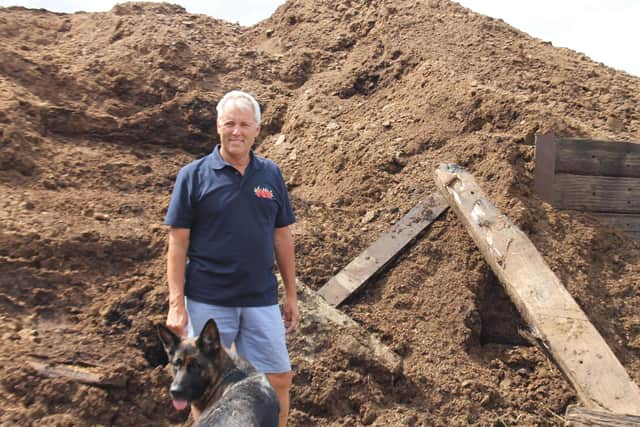
Mr Ward said: “The heap of poultry litter spontaneously combusted and the railway sleeper wall around the whole heap went up in flames too.
“We created a fire break to protect the crops and firefighters hosed it down to control it, they then followed up with thermal imaging gear to check for hotspots within the heap.
“The situation was desperately worrying given the fire was next to thousands of acres of unharvested wheat in our fields and those of our neighbours, the consequences of it all going up don’t bear thinking about.
“This could have been so much worse but everyone acted quickly and the fire service were really good and they did a great job.
“I would like to thank them, the team here and our neighbours for helping to prevent its spread.
“We are very careful on the farm and have taken precautions but it does show why it is so important businesses are prepared.
“We need to see these adapters are rolled out further among the fire service in all counties."
The Met Office has warned that temperature extremes are becoming normal as shown by the hot and dry weather over the spring and into summer.
The risk of fire due to tinderbox conditions puts livestock and crops at risk but also people and their homes as fires can spread quickly and unpredictably.
Rhonda Thompson, who is also NFU Lincolnshire county adviser, said the importance of having the adapters on farms and on fire engines was clearly demonstrated following the fire at her home.
She said: “Thankfully our neighbour alerted us as the fire was some way away from the farmhouse and the team here and other local farmers sprang into action working with the firefighters.
“Every minute the fire was unattended added to the risk and we were concerned that it would spread quickly.
“Two fire engines arrived quickly from Nottinghamshire and Lincolnshire and, fortunately, the Lincolnshire fire engine was carrying the adapter, developed by farmer Ian Watson.
“The firefighters were able to make use of our on-farm water stores and neighbours’ water bowsers and tankers to put it out.”
Farm fires can start in a multitude of different ways, from combine harvesters overheating to disposable barbecues being left in fields.
As well as farmers and growers doing what they can to prevent and manage fires, the NFU is asking:
- All fire services to invest in a newly developed adapter to enable fire engines to access on-farm water bowsers and tanks.
- Government to introduce legislation requiring manufacturers to ensure combine harvesters are equipped with fire suppression mechanisms at the point of sale.
- Local authorities to start issuing PSPOs (public space protection orders) on activities that risk wildfires, such as lighting barbeques and setting off sky lanterns.
- Government to avoid changes in land management policies – particularly in the uplands – which could actually increase wildfire risk in dry conditions.
NFU Vice President Rachel Hallos said: “The fact Ian Watson has worked to develop an adapter specifically for rural areas, then managed to secure funding for all 48 fire engines in Lincolnshire to be equipped with it, shows what can be achieved when we work together and put our minds to it.
“These adapters have been instrumental in minimising the impact of farm fires on livelihoods, and I believe it should be a non-negotiable for all fire engines across the country to invest in.
“They aren’t expensive, yet the cost of a farm fire can be devastating.
“There are solutions out there, and what we’re asking for will help tackle some of the key causes and risks of wildfires.”