
Regenerative agriculture, practised in Lincolnshire
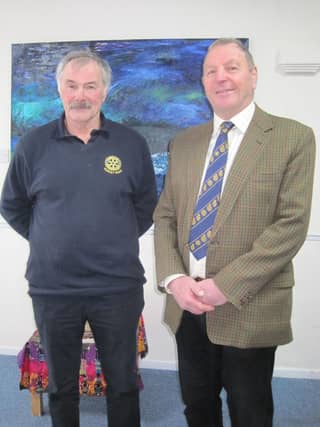

Local farm and Rotarian James Walgate was introduced to Market Rasen Rotarians at their latest meeting as their guest speaker.
James farms about 1700 acres at Hall Farm, Cuxwold, on the Lincolnshire Wolds near Caistor.
Since the 1980’s farming has undergone many changes, going from maximising yield at more or less any affordable cost to the present situation of massively reduced support and a much greater concern for the soil and the environment. James spoke about Regenerative Agriculture, soil health and agriculture. His main cropping plan includes winter wheat, spring barley, spring beans, spring oats, linseed and a novel oil crop – winter Ahiflower. Ahiflower (Buglossoides arvensis) is a regeneratively grown oil crop cultivated mainly in the UK with a common name - corn gromwell. The seeds are cold-pressed to produce a light, clean oil used in supplements, skincare, and wellness products. It is positioned as a sustainable, plant-based alternative to fish oil and evening primrose oil.
Four years ago, James decided that they had to try and bring animals back onto the farm because of the growing interest in regenerative agriculture and the benefits of animals in the nutrient cycle. They established a flock of sheep which has been enlarged over the last four years. Also, they have introduced a pig ‘bed and breakfast’ operation – pigs are brought onto the farm where they stay and are looked after until they go back to their owners. These pigs are a good way of converting straw, from the harvested crops, into farmyard manure which is then spread on the land.
The farm at Cuxwold is on light sandy loam land on a chalk subsoil. James recalled his younger days being lectured about these light soils – the worst thing that you could do is to plough, cultivate and prepare a seedbed, plant the seed and roll it all flat. All this is destroying the organic matter and so damaging the soil. However, at that time there was really no other viable alternative.
In 2015 James went on a trip to Brazil and met John Landers, an English agronomist who worked as a consultant for Shell Qumica, a Royal Dutch Company who took over Rothwell Plant Breeders. He is one of the main flag wavers and considered to be the grandfather of the ‘No-Till’ movement in Brazil. On returning to England, James was confronted with a 10% cut in his sugar beet acreage by British Sugar. This gave an opportunity to try out growing a cover crop on the unwanted sugar beet acreage and the possibility of direct drilling winter wheat into it in the autumn. Following this a direct drill was purchased in 2017 and since then there has been no ploughing on this farm. James then went on to explain his thinking on what was happening with ‘conventional farming’:
· Yields are plateauing despite ever increasing inputs.
· Pests and diseases are becoming a big issue.
· Soils are becoming depleted so there is more reliance on synthetic fertilizers and the soils are becoming dysfunctional
· Resistance to existing plant protection chemicals is widespread and there are few if any new chemistry options available. The policies of the EU have resulted in the removal of many useful chemicals from the market.
A healthy soil results in healthy plants but over the last few decades ‘conventional farming’ has broken this relationship – we now need to try and repair it. We need to work with nature and not against it. There is free energy available from the sun, we have CO2 in the air and we have water in the soil.
Through photosynthesis, plants can use all these elements to produce carbon-based compounds. 40-60% of these compounds are exuded from the roots into the soil. These exuded items go to feed the organisms of the soil microbiome – all the fungi, bacteria etc that survive in the soil. So, the energy trapped by photosynthesis goes down into the soil to maintain all the organisms that depend on it. The plants and the soil they are growing in exist in a symbiotic relationship – the plant needs various nutrients and these are made available through the soil rhizosphere, in turn the plants provide the energy and nutrients necessary to maintain a healthy rhizosphere. When a plant is attacked by a disease or pest it can respond in a similar way to that way humans do - with our immune system.
We need to start with an aerobic none compacted soil. We need to maximise the use of photosynthesis to feed the rhizosphere and to maintain the life in the soil. For example, if we take a crop of winter wheat, this will be growing actively in the ground from say October through to harvest in August.
After harvest the roots will die and stop providing food for the soil and the soil microbiome will go into a dormant state. Intercropping with a suitable alternative crop which remains active after the wheat harvest would be a solution that keeps the soil in an active state. Intercropping is now becoming popular, and legumes such as beans or clover are a good example of crops that can grow alongside cereals.
James has found that he could establish an under-crop of white clover and then direct-drill winter wheat into it. The clover will fix nitrogen from the atmosphere and is able to survive amongst the wheat crop. After harvest the clover will continue to grow and maintain the soil organisms. It will also allow James to graze his flock of sheep to feed them on the clover - and provide further nutrients for the soil.
Controlled Traffic systems one option to keep the unwanted, unhealthy, soil compaction to clearly defined areas, by all machines travelling over exactly the same ground – tram lines.
Another system to avoid this compaction problem James has employed – Controlled Pressure. This alternative system requires that all equipment that travels over the field should have low pressure tyres, all tractors and any trailed implements. However, for these machines to travel on the open road the tyre pressure needs to be high to prevent tyre wear and to keep the machines steady at speed.
On entering the field James has a system of reducing all the tyre pressures to give the low ground pressure requirement. The tractor is fitted with an air compressor which can automatically restore high tyre pressure before leaving the field.
Also to consider is the reduction or elimination of all pesticides fungicides and herbicides. Currently not completely possible, but reduction in application rates and frequency is being achieved. The aim is also to eventually eliminate application of artificial fertilizer and instead rely on a healthy soil, with a fully functioning nutrient cycling system which will provide all that the crop needs.
The change in practice to this new sustainable farming will take time, the soils must be built up and the cropping systems modified to maximise this new regime. Nitrogen application for a winter wheat crop used to be 240kg/ha and this would have been common under the ‘conventional’ system, James is now only applying 100kg. Where previously he was applying up to four fungicides per crop he now only applies one. He is not using any seed dressings, no growth regulators and no insecticides. The result will be a healthy plant, a healthy food web and nutrient cycle in the soil, better nutrient content in the harvest crop and better keeping quality in the final products.
Finally, James pointed out that in nature there is no system of applying artificial nutrients and yet there are vast areas of the globe covered with vigorous healthy plant life which have never seen any artificial fertilizer – how is this possible? One suggestion is the phenomenon of Rhizophagy. Rhizophagy is a plant–microbe interaction in which root cells take in living microbes, strip nutrients from them using reactive oxygen, and then release the surviving microbes back into the soil. It is a nutrient-acquisition strategy that sits alongside mycorrhizae, nitrogen fixation, and classical root uptake, but it works in a very different, almost cyclical way.
The aim now is to work with nature rather than against it.
Probably around 5% of farming is under a regenerative system but there is a lot of interest so it will definitely grow especially on the lighter land – not so easy to apply to heavy clay.
Rtn. Bill Emms then thanked James for his very clear and explicit explanation of the benefits to be had from these newer systems of farming – however, Bill was wondering if perhaps we were heading back to the days of the Four Course Rotation which were introduced in the early 1700’s particularly in Norfolk and spread widely in the 18th and 19th centuries.