
Boston-area secondary school 'requires significant improvement', Ofsted rules, despite finding grounds for praise
A secondary school near Boston ‘requires significant improvement’, Ofsted has ruled, despite finding grounds for praise.
The education watchdog published its latest report on William Lovell CofE Academy, in Stickney, on Thursday (May 21), following an inspection in March.

Ofsted no longer gives an overall judgment for schools, such as ‘outstanding’ and ‘inadequate’. Instead, it publishes ‘report cards’, with grades awarded in different areas. These grades, in descending order, are: ‘exceptional’, ‘strong standard’, ‘expected standard’, ‘needs attention’ and ‘urgent improvement’.
William Lovell was awarded ‘expected standard’ in two areas: inclusion, and personal development and wellbeing.
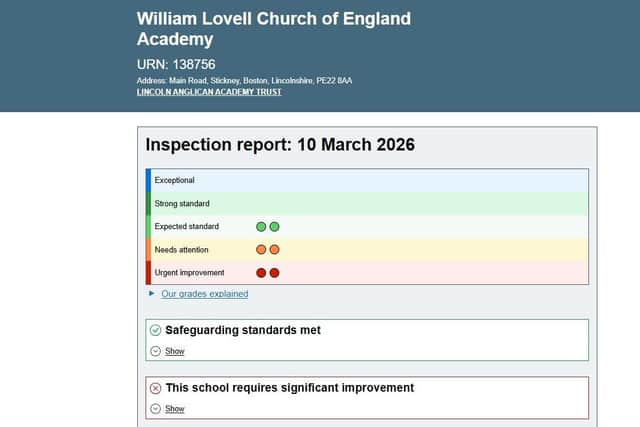
However, in four areas it was classed below this level.
Two were given as ‘needs attention’: curriculum and teaching, and leadership and governance; and two were said to require ‘urgent improvement’: achievement, and attendance and behaviour.
The new approach is meant to offer a more nuanced perspective.
However, despite this, William Lovell’s report still features the words, in bold, ‘this school requires significant improvement’.
“His Majesty’s Chief Inspector is of the opinion that this school requires significant improvement because it is performing significantly less well than it might in all the circumstances reasonably be expected to perform,” it explains.
When the report goes into detail, nuance can be found and the school fares better. Here, inspectors find grounds for praise, even in areas which are felt to be below the expected standard.
Comments include:
- “Pupils feel safe and can be themselves in this friendly school. They enjoy positive relationships with caring staff, who treat them with ‘unconditional positive regard’. The school works hard to get to know each pupil as an individual. Many pupils say they enjoy coming to school. However, a significant number of pupils do not attend well. They miss out on learning.”
- “Pupils, including disadvantaged pupils, do not achieve as well as they should. Pupils are not being prepared well for the next stage of education. While pupils’ experience of learning is starting to improve, teaching is not yet consistently effective. Some groups of pupils receive support to get better at reading, but many others miss out. They have gaps in their reading, writing or mathematics knowledge. Leaders know that the curriculum and teaching need to improve to ensure that pupils achieve more highly.”
- “The school has set high expectations of how pupils conduct themselves. Most pupils meet these expectations consistently. As a result, the school is calm and orderly. On occasion, there are disruptions to learning or pupils do not treat each other well. When this happens, leaders ensure that pupils get good support to behave better next time. As a result, suspensions are falling. Pupils say bullying does not happen often. They trust the school to deal with it if it does.”
- “Pastoral support is a strength of the school. Pupils benefit from a well-planned programme of personal development that includes a range of clubs and activities, like chess, rugby and singing clubs. Pupils get high-quality careers information and guidance. They value the opportunity to do meaningful work experience. As a result, pupils have ambitious plans for further education, work or training.”
The ‘report cards’ also state whether safeguarding standards are being met; here, William Lovell received a green tick.
In a statement, headteacher Emma Bennett said: “We welcome the findings of our recent Ofsted inspection and are pleased that inspectors recognised the clear direction and determination driving our school forward. They confirmed that leaders have identified the right priorities and are already implementing effective strategies for improvement, with early signs of positive impact seen in pupils’ work.
“The report highlights significant strengths that reflect our daily practice. William Lovell is a caring and inclusive community where pupils feel safe, valued and able to be themselves. Strong pastoral care, high-quality safeguarding, and a clear commitment to personal development ensure that our students grow into confident, responsible individuals. Inspectors also recognised improvements in behaviour, effective careers guidance, and the strength of our work supporting pupils with SEND (special educational needs and disabilities), ensuring they feel they belong and can succeed.”
Mrs Bennett said the school was ‘already taking decisive action’ to build on its foundations.
“Investment in expert staff, strengthened professional development, and a renewed focus on literacy and teaching consistency are central to our improvement journey,” she said. “These actions are supported by clear leadership at school and trust level, alongside our governors and partners, and a shared ambition to ensure every student achieves their potential.”
Continuing, she said: “As an inclusive school, we also recognise the challenges we face under the new inspection framework. It is important to recognise the wider national conversation around how schools are evaluated, particularly in rural and disadvantaged communities.
“Ensuring strong attendance remains a key priority, particularly where complex needs and external factors impact young people. These challenges can affect both achievement and progress. However, we are committed to working closely with families and partners to overcome these barriers and secure the best outcomes for all pupils.”
Concluding, she said: “We would like to thank our dedicated staff and supportive families for their continued hard work and partnership, which are vital to the progress we are making as a school community.”