
Video technology for faster treatment for stroke patients being rolled out across Lincolnshire

A pioneering video assessment service which is transforming the way patients with stroke symptoms receive care, enabling faster, more accurate treatment and reducing pressure on busy A&E departments, is being rolled out across Lincolnshire.
The digital technology sees East Midlands Ambulance Service (EMAS) staff consulting directly with stroke specialists via video call whilst at the scene of an emergency, ensuring patients are taken to the right care centre, first time.
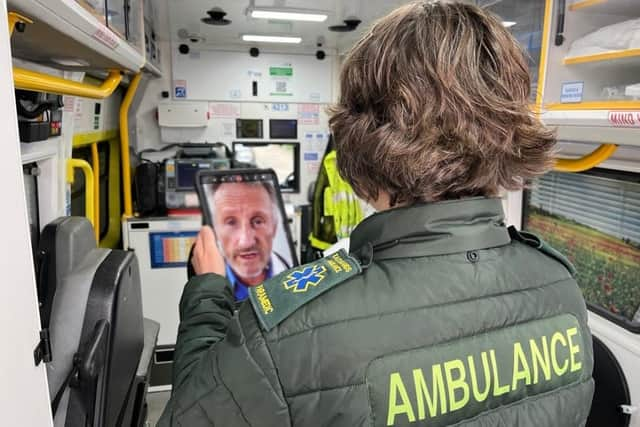

EMAS says time is vital for effective stroke treatment, meaning for patients across urban and rural communities, this technology reduces further transfers to specialist units from emergency departments by taking patients to specialist units straight away, and enables scanning and treatment resources to be pre-alerted, ready for the patient’s arrival.
Video triage is also helping identify conditions that mimic stroke symptoms, such as Bell’s palsy, infections, migraines, and transient ischaemic attacks (TIAs). These may not require a visit to specialist stroke centres, instead being supported by A&E, GPs or other services, ensuring patients receive the most appropriate care for their symptoms.
The partnership initiative, initially rolled out across Leicestershire, is now beginning in Nottinghamshire and Lincolnshire.
Since launch, the Leicestershire pilot has seen 318 patients assessed by video call as of September 2025, with 20 per cent of patients being recognised as not stroke related, and diverted to other services without the need to attend A&E.
The results will also be used to improve understanding of the risk of stroke across communities in the East Midlands, improved stroke awareness and equality of access to specialist stroke services.
This innovation aligns with the NHS’s 10-year plan and key ambition to shift from analogue to digital. The technology is available 24/7 in Leicestershire, providing round-the-clock support for both patients and healthcare professionals, providing ambulance crews with chances to learn from stroke experts to be better prepared when visiting future patients.
John McKenzie, Clinical Improvement Manager for EMAS, said: “Pre-hospital video triage (PVT) is improving our crews’ ability to best support patients, by using technology to access specialists quickly. This means faster access to the right treatment for patients, working together with hospital partners.”
Dr Amit Mistri, Head of Service for Stroke and Clinical Lead for PHVT at University Hospitals of Leicester, said the pre-hospital video triage pilot is already making a meaningful difference to patients and helping to ease pressure on busy hospitals. He said: "This collaboration has strengthened ties between EMAS and our stroke service, enabling faster prioritisation for those with suspected stroke and supporting timely clinical decision-making. For patients whose symptoms have resolved or where stroke is unlikely, we’re able to safely redirect them to more appropriate services, whether that’s urgent TIA clinics, same day emergency care, or community providers, ensuring every patient receives the right care, in the right place, at the right time.”
Kevin Botham, Senior Manager at East Midlands Integrated Stroke Delivery Network (ISDN) added: “We worked with NHS England to secure funding for this pilot and I’m delighted that patients are really benefitting. We have been able to take learning from this and scale-up the approach to cover the rest of the East Midlands, such has been its success. This means all our trusts in the region have benefited from the £150,000 investment so patients are triaged to the right service in that vital timeframe when stroke symptoms emerge.”
Sarah Adderley, Associate Director for the Midlands, at the Stroke Association, said: “We hope it will improve the outcomes for the 90,000 people that survive a stroke each year in the UK.
“It is the country’s fourth leading cause of death and the leading cause of complex adult disability. Yet, in an instant, time sensitive treatments like thrombectomy, can significantly reduce the chances of a stroke survivor being left with disabilities which can restrict their ability to walk, talk, or even swallow.
“Stroke is a medical emergency and patients must receive fast treatment and care to give them the best chance of survival and recovery. 1.9 million brain cells are lost every minute after a stroke – that’s why we say, ‘time is brain’”
A stroke is when blood stops flowing to a part of your brain. A stroke needs urgent medical help because it can be life-threatening.
The main symptoms of a stroke can happen suddenly. They may include:
face weakness – one side of the face may droop and it might be hard to smile
arm weakness – may not be able to fully lift both arms and keep them there because of weakness or numbness
speech problems – words may be slurred or sound confused
The easiest way to remember these symptoms is the word FAST. This stands for: face, arms, speech and time to call 999. Showing just one symptom is enough to act FAST. More information: https://www.nhs.uk/conditions/stroke/symptoms/