
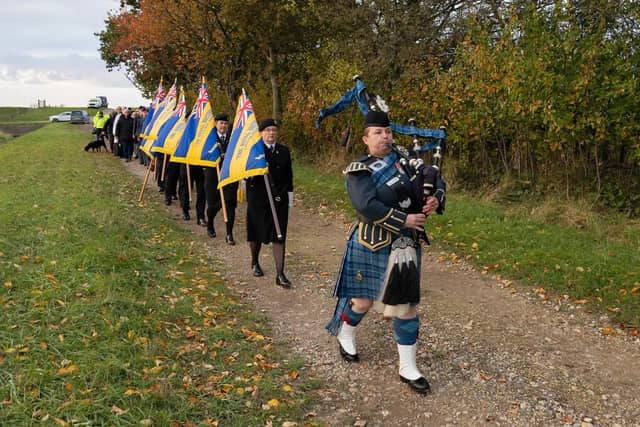

The Seven Lights at Sunset Ceremony was held at the recently completed R5683 Memorial, near Benington, on Sunday (October 18).
The event honoured the crew of 106 Squadron Lancaster R5683, which crashed on the Butterwick Low mudflat on the night of July 26, 1942.
The crew comprised three Englishmen, a Scotsman, a Welshman, a Canadian and an Australian. They had been heading for an operation over Duisburg, Germany. There were no survivors.
Sunday’s event involved seven lanterns being lit, one by one, as daylight faded, one for each member of the crew.
The timing of the ceremony was designed to link the crew’s tragic final flight with the traditional words of Remembrance – ‘At the going down of the sun, and in the morning, we will remember them’.
The event was organised by Flt Sgt Andrew Copley, of RAF Coningsby, who has spent more than a decade researching the crew and establishing the memorial.
“The opening address emphasised that every light represented an individual, a son, brother, friend and young man with hopes for the future, while together the seven represented one crew,” he said.
“The ceremony also drew on the Christian symbolism of light. A passage from the Gospel of John ‘The light shines in the darkness, and the darkness has not overcome it’ reflected the message that, although the crew’s final flight ended in darkness, their story endured through family accounts, photographs, letters and service records, and now through the memorial near the place where their journey ended.”
The event was attended by descendents of two crew members: Olly Brewer, great-nephew of pilot Flt Sgt Geoffrey Appleyard, and James Lake, great-nephew of rear gunner Sgt James Douglas Davie.
Flt Sgt Copley said: “Their presence renewed the connection between the airmen’s families and the Lincolnshire community, where the aircraft’s story has remained rooted for more than eight decades.
“Some crew members had stayed with friends only a few miles away in 1942, making the event both a remembrance of a wartime loss and a reconnection between the crew, their families and the local area.”
Flt Sgt Copley thanked the families of all seven men for entrusting him with their stories and supporting his work. He also thanked the Saul family and those connected with the farm for allowing the memorial to be established on their land. He paid particular tribute to his wife and daughter for supporting the project and helping to bring the memorial into being.
Others to have backed the work have included: the Royal British Legion, the 106 Squadron Association, the We’ll Meet Again Second World War Museum, and His Majesty’s Coastguard.
Following the success of the inaugural event, Flt Sgt Copley says he intends the Seven Lights at Sunset to become an annual ceremony.
Further information about the memorial and its location can be found on the memorial’s Facebook page by searching for Lancaster R5683 Memorial.
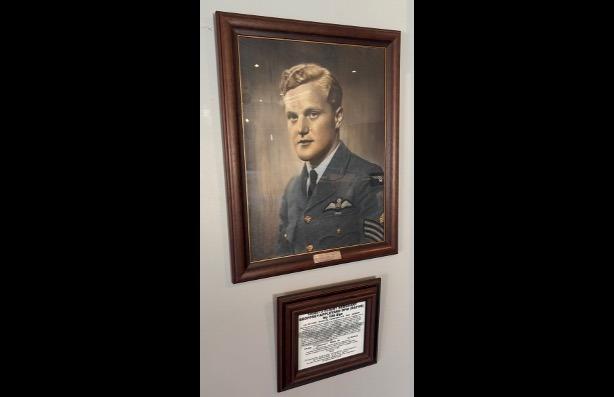
9. 12. Appleyard Mess picture borders.jpg
Flt Sgt Copley – who has lived in Boston for about 20 years – first became interested in their story through a painting hanging in RAF Coningsby’s Warrant Officers’ and Sergeants’ Mess. The portrait depicts the pilot of the Lancaster, Flt Sgt Geoffrey Appleyard, and had been presented to the station by his mother during the war. Photo: Contributor
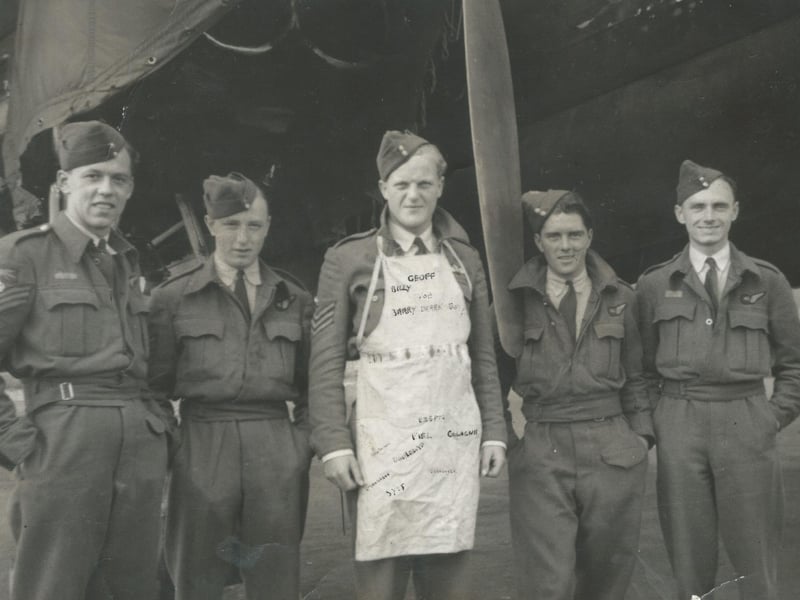
10. Seven Lights at Sunset Ceremony
Geoffrey Appleyard and other crew members from the lost Avro Lancaster. The apron in the photo belonged to Kathleen Neal, whose family farmed near Benington. She had got to know Appleyard and several members of the crew through wartime dances at Boston's Assembly Rooms. After successful operations, she embroidered small bombs and target names onto the apron. Following the crash, she attended Geoffrey's funeral, where she met his family. Later, she would become godmother to Geoffrey's niece. Photo: Contributor