
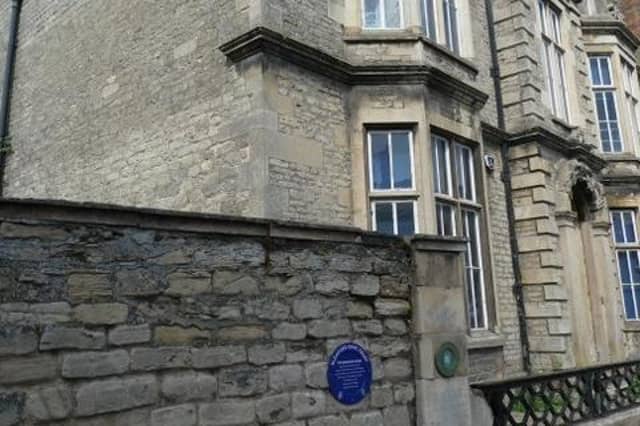


The unveilings were On Monday August 11, with the first one being at The Mansion House on Southgate.
Faith Hopkins from the Trust explained that this year on August 10 marked the 200th anniversary of the birth of local architect and builder Charles Kirk the Younger who had The Mansion House built as his home. The 11 August was the nearest the Trust could get to his anniversary to hold the unveiling.
Situated next to Yorkshire Trading on Southgate, it is now used by the sixth formers at Kesteven and Sleaford High School and the plaque has been positioned on the wall adjacent to the Mansion House. David Marriage, chairman of the Civic Trust, led the introductions and local historian Mike Turland did the unveiling and later gave a talk about Kirk & Parry.
According to the Trust, the Kirk family had long been connected with the building trade and Charles' father William was himself a surveyor and monumentai mason.
Charles Kirk first came to Sleaford in 1829 to undertake the building of the new Town Hall and Court House and when the work was completed he decided to stay. ln the years that followed, Kirk's building business and architectural practice flourished and he was involved in the construction and planning of many of Sleaford's new buildings of the period.
Many of Charles Kirk's later building projects were undertaken with Thomas Parry who had begun his career as an articled clerk with Kirk's firm. The two men eventually went into partnership and became more closely connected in 1841, when Parry married Charles Kirk's daughter, Henrietta. Following Charles Kirk's death in 1847, his son Charles the Younger took over, building his own house (known as Mansion House) on Southgate in 1850.
ln partnership with his brother-in-law the business continued to prosper, establishing a countrywide reputation for their railway and civic buildings and church restorations. They are thought to have been the fifth biggest London building firm in 1861, with a Westminster office. Parry reported 1,081 employees in the census. in 1866 Charles Kirk the Younger and Thomas Parry bought a coalmine with 466 employees.
Charles Kirk the Younger had a passion for churches and in his obituary claimed 65 of which 22 were "prominent". Of 94 churches in Kesteven outside Stamford, Kirk probably worked on 35 of them.
He was churchwarden at St Botolph’s, Quarrington for 40 years; and at St Denys’ for 20.
He also surveyed and excavated Castlefield in 1863.
Losing his first wife in 1882 he remarried in 1898, and in 1901 they moved to Dorrington, where he died in 1902, worth £1.5million in today’s money. The Civic Trust party then moved over the road to the Monument Gardens where a small brass plaque was unveiled dedicated to Charles Ellis who was for a long time the History Master at Carres Grammar School from 1946 - 1976 and taught many local boys, many of whom as grown men, can still remember Charles.
This plaque has been placed on the post which holds the two Sleaford Town Signs which have been beautifully renovated for the Civic Trust by Harriott Brand. The plaque was unveiled by historian Dr Simon Pawley who then gave a talk about Charles. Both Simon and Mike were taught by Charles too. Faith said: “It was a very successful morning and the Civic Trust will now be moving on to the siting of more commemorative blue plaques around town.”
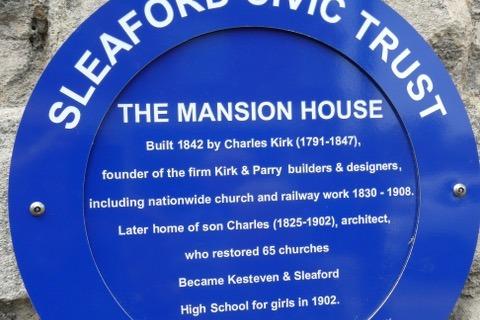
1. Mansion House Plaque unveiling.jpeg
The new plaque with notes on the history of The Mansion House. Photo: supplied
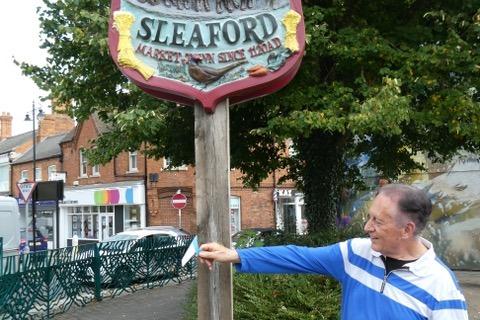
2. Charles Ellis Plaque.jpeg
Dr Simon Pawley reveals the plaque to Carre's history master Charles Ellis. Photo: supplied
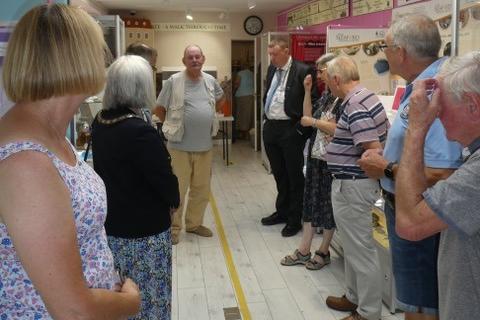
3. Kirk Plaque unveiling.jpeg
Historian Mike Turland gives a talk at Sleaford Museum after the unveiling. Photo: ugc