
Man who fatally stabbed nine-year-old girl in Boston convicted of murder
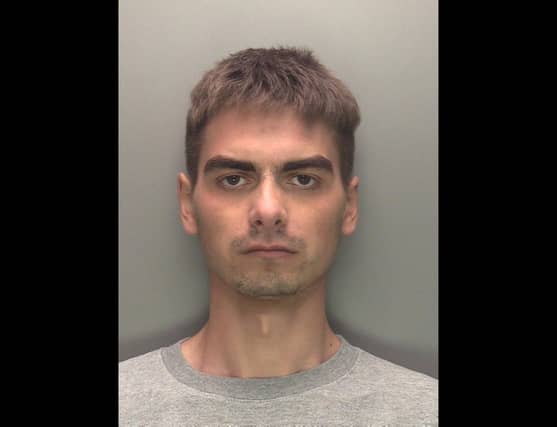

A man who fatally stabbed a nine-year-old girl in a street in Boston was today (Thursday, February 5) convicted of her murder – three-and-a-half years after he carried out the killing.
Lilia Valutyte was playing with a hula hoop outside a shop where her mother was working when she was stabbed by Deividas Skebas on July 28, 2022.
The Lithuanian factory worker, now 26, was unable to face a jury in the months after the killing after it was decided he was unfit to enter a plea.
However, prosecutors pursued a murder charge against Skebas following an improvement in his mental health during 2025 and he was deemed fit to go on trial.
A jury at Lincoln Crown Court today found Skebas guilty of Lilia's murder by an 11-1 majority verdict after deliberating for more than seven hours.
Skebas, who is currently being held at Rampton high security hospital, was not present in court and watched the jury return their verdict via a live video link. He showed no reaction as the jury returned their guilty verdict.
The trial judge, Mr Justice Choudhory, adjourned sentence on Skebas until February 25, but did not address him directly.
Addressing the jury, Mr Justice Choudhory said: “I appreciate it has been a difficult experience for you.”
Following the verdict, Lilia's stepfather, Aurelijus Savickas, read out two moving victim impact statements on behalf of himself and Lilia's mother, Lina Savicke.
In her statement Ms Savicke, said Lilia would have turned 13 on February 2.
Ms Savicke revealed they had also visited Skebas's hometown where his mother ran a flower shop, adding: “Why, for what? I can not comprehend.”
Speaking about Lilia, she said: “For nine years, we lived fully, visited many places.”
But Lilia's mother concluded her statement by stating ‘this is not something you recover from’, asking: ‘why here, why us? The question remains unanswered’.
In his statement, Mr Savickas said he had come into Lilia's life when she was three years old.
“From that moment, we walked our journey together,” Mr Savickas explained. “I loved her as my own.”
Mr Savickas told the court of Lilia's love for drawing and painting, and described how she hugged and kissed him before he went out to work on the morning of her murder, adding ‘our last moment together’.
He concluded by saying: “Lilia, you will forever live in our hearts. You are forever loved, forever missed.”
Skebas had admitted unlawfully killing Lilia with a single stab wound, but denied murder claiming his responsibility was diminished by his schizophrenia and psychotic state.
But prosecutors described the killing as ‘wicked’ and alleged it was deliberately planned after Skebas, a former altar boy, picked on a child in the street.
The court was told expert psychiatric evidence from Dr Ian Cumming that Skebas was psychotic at the time of the killing and that his responsibility was diminished.
Defence barrister Andrew Campbell-Tiech argued the only rational explanation for the killing of Lilia was mental illness.
But prosecution barrister Christopher Donnellan KC described the murder as ‘deliberate and planned’, and insisted Skebas was capable of rational thoughts despite his mental illness.
The court was told Skebas had spent several months in three mental institutions during 2020 – two in Vilnius and one in the UK.
His fatal attack on Lilia was carried out just three weeks after Skebas returned to the UK from Lithuania and two days after he purchased a knife from a Wilko store in Boston.
CCTV which was played in court showed Skebas making five laps of the Fountain Lane area where Lilia was playing in the 69 minutes before the stabbing.
Mr Donnellan suggested Skebas ‘was on the prowl’ and appeared to be waiting for the street to go quiet in the minutes before he chose to kill Lilia rather than anyone else.
The prosecutor said Skebas then ran off after killing Lilia and escaped through a planned route.
“He knew what he was doing, he knew it was wrong,” Mr Donnellan told the court.
Jurors were shown footage of Skebas approaching Lilia at around 6.15pm after he pulled out the knife from his back pocket, but the moment he stabbed her was obscured by a road sign.
Despite the efforts of an off-duty police officer who noticed Skebas running away and went to help Lilia, she was pronounced dead from the single stab wound at 7.11pm.
Mr Campbell-Tiech acknowledged that Skebas confessed to the murder, ‘as he saw it’, after he was arrested two days later at his address in Thorold Street, Boston.
The knife and a grey Calvin Klein t-shirt containing DNA belonging to Lilia were recovered from property, and Skebas was preparing to flee back to Lithuania.
Mr Campbell-Tiech claimed the reasons provided by Skebas for the killing during his police interviews were consistent with psychosis.
In his limited accounts to the police, Skebas said he was being controlled and made references to both NASA and a microchip.
Skebas also described how he was told ‘to do’ Lilia and showed officers a mark on his chest where he believed the chip had been put inside him.
But Mr Donnellan urged the jury to concentrate on the narrow period of the killing and said Skebas ‘was not an unintelligent man’.
Mr Donnellan stressed that Skebas had not attacked anyone else after buying the knife from a Wilko store in Boston two days before the killing, and had taken cannabis despite its impact on his condition.
Jurors were also asked to consider the evidence of a clinician who visited Skebas in his cell at Boston police station 73 hours after the killing and found no evidence of psychosis.
Skebas was found unfit to stand trial in the months after the stabbing and later transferred to Rampton high security hospital.
Jurors were also shown footage of a blood covered Skebas in his cell at Wakefield prison after he was repeatedly stabbed by another inmate on August 21, 2022.
In July 2023, a jury found Skebas carried out the act of killing Lilia, and two years later, following an improvement in his mental health, it was decided he could face a murder trial.