
East Coast will experience 'rapid deterioration' without major investment to flood defences, council bosses warn
More than 60,000 people are at risk of flooding if Lincolnshire’s coastal defences are not fixed, warn senior council officials.
Lincolnshire County Council’s (LCC) head of environment, Chris Miller, has warned that the east coast could face ‘rapid deterioration’ and £5.5 billion damage without a major investment in the region’s flood defences – putting peoples’ homes and livelihoods in danger.
At a meeting on Friday, May 15, Mr Miller told members of LCC’s environment scrutiny committee that the flood defences across the east coast – serving towns such as Skegness, Mablethorpe and Sutton on Sea – are not fit for purpose.
He added: “If a significant breach occurred under current conditions, over 60,000 residents would be at risk, along with thousands of homes, caravan parks and critical infrastructure such as roads, rail links and utilities.
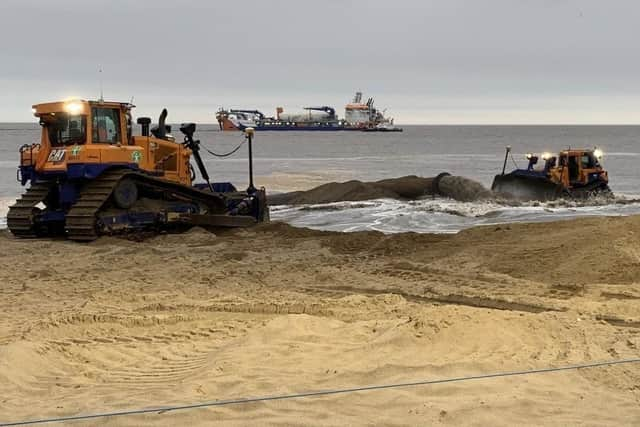

“Flood depths could reach up to 2.5 metres (more than 8ft) in some areas, with water velocities of around five metres per second, making evacuation and emergency response very challenging.
“The economic impact would be devastating, with direct damage to property, infrastructure and farmland estimates a conservative estimate of £5.5 billion – and that is excluding some of the indirect costs like business disruption and loss of tourism, income and long-term social and environmental consequences.
“It wouldn’t just destroy the physical assets but could undermine the viability of entire communities, force relocation and cause severe economic and social disruption.”
Mr Miller went on to say that most flood defences have less than 15 years of use left – and are not suitable to be used as the foundation for replacements.
He added: “The investment is likely to be required earlier than previously thought and with costs beyond what can be secured through the normal flood and coastal and flood management grant.
“That alone would not be enough and the shortfall is likely to be in the billions of pounds bracket.”
Mr Miller explained that although the Environment Agency has applied for funding to carry out the repairs, this is unlikely to be enough for the scale of the task in hand.
He added that the Environment Agency spends approximately £10-15 million per year maintaining the east coast’s flood defences.
He added: “Without these defences, communities such as Skegness, Sutton on Sea, Mablethorpe, would be inundated by the North Sea on more than half the high tides each year.”
He said that residents and businesses living in these areas are “under threat” of “tidal flooding” because of the “already ageing” flood defences which need to be refurbished.
He added: “Replacing these sea walls to protect our coastal communities will require major investment and the region will have to compete for funds against other long-term major flood risk management projects across England and more locally, such as those on the Thames, the Humber and the Fens.
“The agency alone will not be able to make a viable business case for further investment in the coastline in line with current guidance.”
He explained that the county council is working in partnership with the Environment Agency as well as East Lindsey District Council to address the flood risk across the east coast.
Deborah Higton, from the Environment Agency, said the organisation is developing a plan to deal with these flood risks.
She added: “So, what we need is that broader strategy. This is a single ‘flood cell’.
“So, if we were to have a breach in the defences, what we do know is that the water can travel the 15 kilometres in land, 13, 15, 18 kilometres each way.
“We need to make sure we have a plan for the whole of the flood cell and that’s what the Lincolnshire Coast 2100 plus (programme) will look at.”
The Lincolnshire Coast 2100+ programme is a 15-year project between the Environment Agency, Lincolnshire County Council, and East Lindsey District Council.
The project aims to secure the future of the east coast, improve flood resilience across the region and ensure communities are protected against sea level rises.