
Firm’s £500,000 bill for river pollution fish deaths

*Firm to pay more than £500,000 after 'catastrophic' pollution killed morethan 135,000 fish in Lincolnshire River*
- *OMEX Agriculture Ltd admitted the leak which is thought to be ‘one of

the largest environmental incidents ever recorded in Lincolnshire’*
- *Pollution stretched 46km all the way to The Wash at Boston killing
more than 135,000 fish*
- *Faulty pipe leaked equivalent of more than an Olympic swimming pool
amount of deadly fertiliser into River Witham*
In a prosecution brought by the Environment Agency, a Lincolnshire firm
which leaked liquid fertiliser into the River Witham wiping out more than
135,000 fish has been ordered to pay a total of £510,190.
The pollution – which stretched 46km to The Wash at Boston – is thought to
be one of ‘the largest environmental incidents ever recorded in
Lincolnshire’.
Failure of an overground pipe caused the spill, which devastated nearby
rivers and surrounding woodland.
Impact from the pollution destroyed all invertebrates in the river’s
tributaries for more than 23km downstream of the site.
Immediately after the pollution, the Environment Agency and partners worked
‘tirelessly’ to mitigate the impacts. They restocked the river with more
than 1.5 million fish larvae and 70,000 roach and bream.
And they continue to work closely with East Lindsey District Council and
the Forestry Commission to remedy affected woodland.
Whilst the water quality of the River Witham improved within a few days, it
could take years for the fisheries to recover, the court heard.
OMEX Agriculture Ltd pleaded guilty to the major category 1 pollution
incident at their facility at Bardney Airfield, Tupholme, near Bardney, at
Lincolnshire Magistrates (June 12). Category 1 is the most severe of three
Environment Agency ratings used to grade pollution incidents.
They were ordered to pay a fine of £160,000, ordered to pay costs of
£350,000 and a victim surcharge of £190.
*District Judge Veits* said that the incident ‘…was avoidable had proper
checks been made’. He added that ‘…checks were not clear or well
documented’ and that the failures involved were ‘foreseeable’.
He also said there was: ‘…clear negligence in not having appropriate checks
in place’.
*Leigh Edlin, Area Director at the Environment Agency for Lincolnshire and
Northamptonshire, said:*
“The pollution of the River Witham by OMEX was a devastating event and one
of the largest environmental
incidents we have seen in Lincolnshire.
“The Environment Agency has worked tirelessly to undo the damage,
introducing thousands of fish, and requiring the polluter, OMEX, to repair
the damage that was done.
“Today marks the end of the legal process and we are rightly pleased with
the result in the court. This is one part of a much larger effort, led by
the Environment Agency, to ensure the River Witham is restored and that the
polluter pays financially and legally.”
OMEX Agriculture Ltd, the global company, which has its headquarters at
Lincolnshire, manufacturers liquid chemical fertiliser for the agricultural
industry and de-icer products which it ships around the UK and the world.
In March 2018, approximately three million litres of liquid urea ammonium
nitrate (UAN) concentrate fertiliser escaped from a storage lagoon into the
River Witham and tributaries.
The incident triggered a massive Environment Agency response and
investigation, including the launch of the Environment Agency’s marine
survey vessel.
Fish density within the River Witham was greatly affected and the
population of pike is likely to take years to recover due to the number of
adult fish killed.
Around three hectares of woodland with ancient woodland characteristics was
also damaged with all the trees in the area having to be felled.
The court heard how OMEX, which stores UAN for production of fertilisers,
failed to put in place an appropriate maintenance and inspection regime to
avoid the catastrophic pollution.
Fertiliser was held in two sealed ‘bladder’ bag lagoons, both holding the
equivalent liquid of three Olympic swimming pools, or 7.5 million litres.
Pipework, operated by an electronic pump system, was used to pump liquid
fertiliser from the two lagoons to holding tanks elsewhere on their site.
Road tankers were filled from these, they then transported the fertiliser
for sale. The pump system was manual until 2017, when it was updated to an
automated system by the company’s electrical contractor.
Ultimately, it was the failure of both the overground pipe and an
electrical fault that went unnoticed and enabled the pump to continue
pumping that led to the devastating discharge.
Environment Agency officers discovered a number of dead fish in the River
Witham at Southrey following a report in early March 2018. They traced the
pollution upstream via an increasing trail of dead fish and high ammonia
readings, eventually identifying the OMEX site as the source and
immediately entered the site to report it.
Liquid fertiliser was found ‘gushing’ from the elbow joint of an overground
pipe which left the surrounding ground and woodland sodden with pooling
liquid fertiliser. The pump was immediately switched off but most of the
pollution had already escaped to the river.
On March 8, a temporary dam built on nearby woodland and the fixing of
leaking pipes by OMEX still failed to contain the leak. Saturated ground
and contaminated surface water continued to pose a high pollution risk.
It was halted through excavations at source and the fitting of a culvert
and concrete pipe to keep contamination away from clean water.
Upstream of Bardney Lock, where the pollution entered the River Witham, in
Snakeholme Drain and Scotsgrove Drain, high levels of ammonia remained for
months.
The incident was classified as a Category 1 incident under the Environment
Agency’s Common Incident Classification Scheme due to its major impact on
the environment.
Conservative estimates have the loss of fish life of more than 135,000.
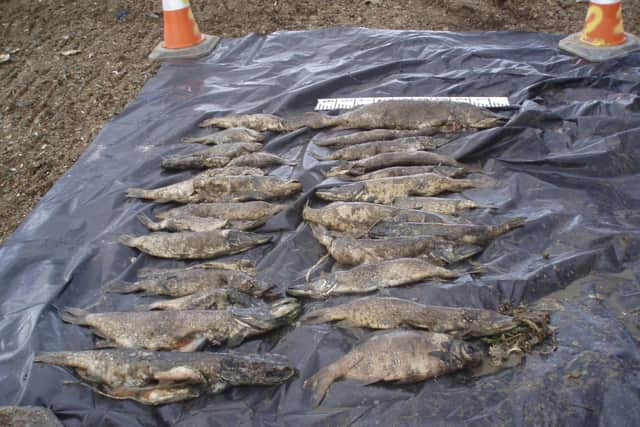
Approximately 1 tonne of dead fish was disposed of at a landfill site
around a month later. This included roach, bream, perch, as well as large
pike, due to spawn.
An independent investigator found the pipe work had separated at the
leaking elbow joint because it was faulty. The review found that had it
been checked when first installed, over 20 years ago, it would have been
identified as faulty but no testing had been done. Overground pipework was
only checked visually and there were no records of those checks.
There was no routine maintenance of electrical systems and therefore
foreseeable electrical faults were not planned for.
In July 2020, OMEX was ordered to carry out river recovery measures set out
by the Environment Agency. Under the Environmental Damage (Prevention and
Remediation) Regulations 2015, the company has been working to restore the
river to its former health.
Fish refuges have been installed across half a dozen locations on the
river. OMEX has also created further backwaters along the river, areas
where fish have calm and still water to breed and shelter.
The company must assess whether fish populations have recovered, or whether
more restocking is required to bring the river back to its former health.
OMEX will be responsible for monitoring and maintaining the improvements
for at least the next decade.
Anyone who suspects a pollution incident is urged to report it to the
Environment Agency’s incident hotline on 0800 80 70 60.
*Notes to Editors*
Omex Agriculture Ltd pleaded guilty to the following charge: On or about
the 3 March 2018, you caused a water discharge activity namely the entry of
poisonous noxious or polluting matter into inland freshwaters, namely the
Scotgrove Drain, Snakeholme Drain, Old River Witham, and River Witham near
Bradney in the county of Lincolnshire, otherwise than under and to the
extent authorised by an environmental permit.
Contrary to regulations 12 (1) (b)and 38(1) (a) of the Environmental
Permitting (England and Wales) Regulations 2016.
The Environment Agency has taken tough action against those companies which
break the rules.
Companies were handed record fines last year, making clear that polluters
will be made to pay for damage to the environment.
The Environment Agency does not decide the fines handed out to companies
and individuals who pollute our rivers. This is down to the courts.
- The Environment Agency has significantly driven up monitoring and
transparency from water companies in recent years, so that everyone can see
what is going on. This includes:
- *Event Duration Monitoring*: this measures how often and for how long
storm overflows are used. The Environment Agency has increased the number
of overflows monitored across the network from 800 in 2016 to more than
12,700 in 2021, the equivalent of almost nine in ten storm overflows now
with monitoring devices. All 15,000 overflows will have them by the end of
2023. All the data is published *online*
.
More info on Event Duration Monitoring can be found *here*
.
- *Flow-to-full treatment*: The Environment Agency has also asked
companies to install new flow monitors on more than 2,000 wastewater
treatment works to identify what is happening at those works during the
sewage treatment process itself. This has led to a major investigation,
announced in November 2021, with the Environment Agency requesting more
detailed data from all wastewater treatment works.
- *Storm Overflows Taskforce: *Through the work of the Storm Overflows
Taskforce – made up of Defra, the Environment Agency, Ofwat, Consumer
Council for Water, Blueprint for Water and Water UK – water companies have
agreed to increase transparency around when and how storm overflows are
used:
- make real-time data on sewage discharges available at bathing sites
all year round.
- publish annual monitoring data on their websites so that progress in
reducing their use can be tracked. The Environment Agency will compile this
data into an annual report that is easily accessible to the public. This
data is also being used at an operational level to prioritise the most
frequent spills for further assessment by EA officers.
- The Environment Agency has taken tough action against those companies
which are breaking the rules:
- In 2021 the Environment Agency concluded seven prosecutions against
water and sewerage companies with fines of £90 million, two of £4 million,
£2.3 million, £1.5 million, £150,000, and £540,000. In 2022 nine
prosecutions were concluded with fines of £1,600,750, £300,000, £240,000,
£233,000, £50,000, and £18,000, £350,000, £871,000 and £536,000.
- The Environment Agency has launched a major investigation into
possible unauthorised spills at thousands of sewage treatment works.
- We will always seek to hold those responsible for environmental harm
to account.
*For East Anglia press office please contact (24 hours): 0800 917 9250*
All Environment Agency news releases, both area and national, can be found
under Announcements at
*www.gov.uk/government/organisations/environment-agency*
Follow us on Twitter @EnvAgencyAnglia
1. Adult pike carcasses retrieved from River Witham following the
pollution.
1. Large adult pike carcass being retrieved from the watercourse.
2. Large fish carcasses retrieved from River Witham, being sent to
landfill.
Information in this message may be confidential and may be legally
privileged. If you have received this message by mistake, please notify the
sender immediately, delete it and do not copy it to anyone else. We have
checked this email and its attachments for viruses. But you should still
check any attachment before opening it. We may have to make this message
and any reply to it public if asked to under the Freedom of Information
Act, Data Protection Act or for litigation. Email messages and attachments
sent to or from any Environment Agency address may also be accessed by
someone other than the sender or recipient, for business purposes.