
Large-scale solar farm plans spark debate across Lincolnshire
Plans for a vast solar farm covering thousands of acres of Lincolnshire farmland have been submitted to the government, prompting strong reactions from campaigners and local groups.
The proposed Meridian Solar Farm would span around 2,700 acres (1,092 hectares) of land near Spalding and is classed as a Nationally Significant Infrastructure Project (NSIP). This means a final decision will be taken by central government rather than the local council.
Developer Downing Renewable Developments said the scheme could provide cheaper, cleaner energy for up to 215,000 homes, alongside boosting the UK’s energy security. The project would also include a battery storage facility and link into the National Grid via a new substation connected to the planned Grimsby to Walpole pylon route.
However, opposition groups say the scale and location of the development raise serious concerns.
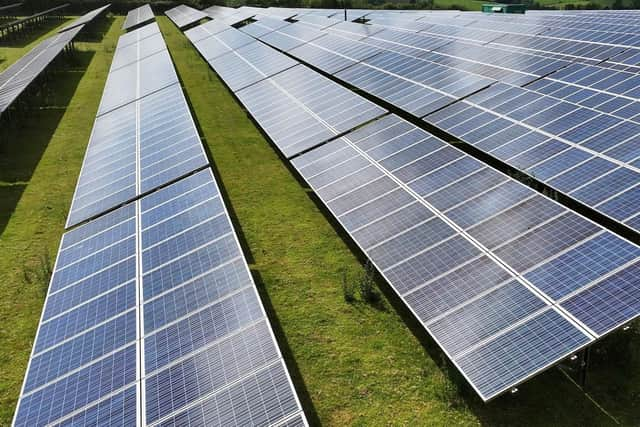

The Meridian Action Group (MAG), which opposes the plans, says the scheme would cover more than 1,100 hectares of what it describes as “best and most versatile” agricultural land. The group says the development would affect communities including Cowbit, Shepeau Stow, Whaplode Drove, Holbeach St Johns, Holbeach Drove, Fleet and Gedney Hill, as well as areas impacted by associated pylon routes.
Campaigners argue that much of the land involved is high-grade farmland, with some classified as Grade 1 – considered among the best in the country for food production.
MAG member David Rains said: “Industrialisation of some of the best food-growing land in the country is just wrong when solar should first of all be on rooftops and brownfield land.
“There is no evidence that, in this case, these other preferred locations have been sought.”
Fellow member Andrew Malkin added: “If this goes ahead there will be thousands of acres of prime land buried, unproductive, beneath glass for the rest of our lives. A generation will never again see these fields green with vegetables or golden with corn.”
Another campaign group, Lincolnshire Against Needless Destruction, also raised concerns about the wider impact of energy infrastructure across the county.
Spokesperson Cat Makinson said Lincolnshire should not be treated as an “easy target” for large-scale developments.
“Meridian is not just another planning application,” she said. “It is part of a much bigger picture of energy infrastructure being pushed through Lincolnshire at unprecedented speed.
“We support the UK’s net zero commitments, but that does not mean accepting poor planning or unnecessary damage to our countryside.”
Supporters of the project argue it would play an important role in delivering greener energy and reducing costs for consumers.
According to the Local Democracy Reporting Service, there are currently 12 NSIPs going through the planning process in Lincolnshire, with some campaigners claiming the county is being unfairly targeted by renewable energy developers.
Lincolnshire is also increasingly being seen as a hub for solar investment in the UK, with several large-scale Nationally Significant Infrastructure Projects either approved or in development. Major schemes include the 500MW Tillbridge Solar project and the 600MW Cottam Solar Project, together representing billions of pounds of investment. These projects are largely being brought forward by independent energy developers, including Tribus Clean Energy/Recurrent Energy and Island Green Power.
The application will now be considered by the Planning Inspectorate through a public examination process. A recommendation will then be made to the Secretary of State for Energy, who will make the final decision.
A DESNZ spokesperson said: “The biggest threat to agriculture and nature is the climate crisis.
“Solar is one of the cheapest and quickest forms of energy to build, getting us off fossil fuels and delivering energy security so we can get bills down for good.
“Even in the most ambitious scenarios, we only expect up to 0.4% of total UK land to be occupied by 2030.”
The process is expected to take more than a year, with public hearings on the Meridian scheme likely to be held later this year.