
Lincolnshire Chalk Stream Project celebrates major milestone

A project which aims to protect and restore England’s rarest water habitats has celebrated its 20th anniversary.
The Lincolnshire Chalk Stream Project (LCSP) involves a variety of organisations working together to restore the chalk streams back to their natural habitat, reduce the flood risk and prevent land erosion.
Fewer than 300 chalk streams exist worldwide and the UK is home to approximately 85 per cent of these crystal-clear, spring-fed waterways – with 11 per cent of these in the Lincolnshire Wolds.
That works out to about 140 miles of one of the most scarce habitats for wildlife on the planet, specifically in Lincolnshire.

Within the Lincolnshire Wolds – an Area of Outstanding Natural Beauty – there are 11 chalk stream catchments and nine principle chalk streams, according to the LCSP.
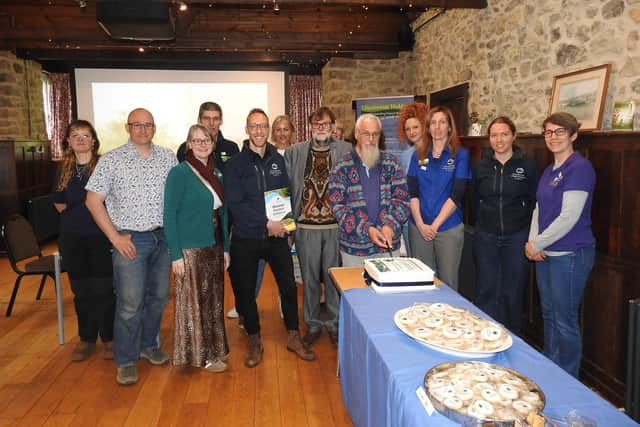
On Wednesday, May 6, the LCSP held an event at Tealby Village Hall, near Market Rasen, to commemorate the project’s success over the last 20 years and look to the future with the launch of a 10-year strategic plan.
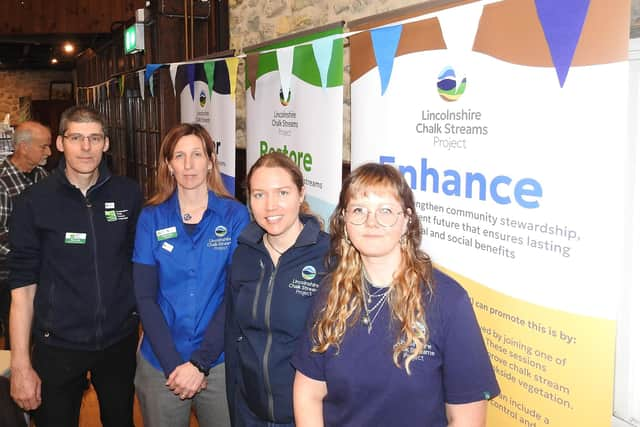
Will Bartle, monitoring officer for the Lincolnshire Chalk Stream Project, explained how the partnership works with young people to monitor the water quality of these streams.
He said: “I work with communities and volunteers and I also run a schools programme as well.

“So, I work with primary schools, secondary schools and further education. We’ve got volunteers who monitor the river, so they’re looking at things like invertebrate numbers, to monitor the water quality.
“We’ve also got a practical group, so we go out and look at previous restoration sites to help maintain them.
“We also work with local communities to try and help restore the rivers or remove litter to keep them nice and clean.”
Mr Bartle referred to the River Rase – which flows through Tealby – and the work they have done to reduce the risk of flooding to neighbouring properties.
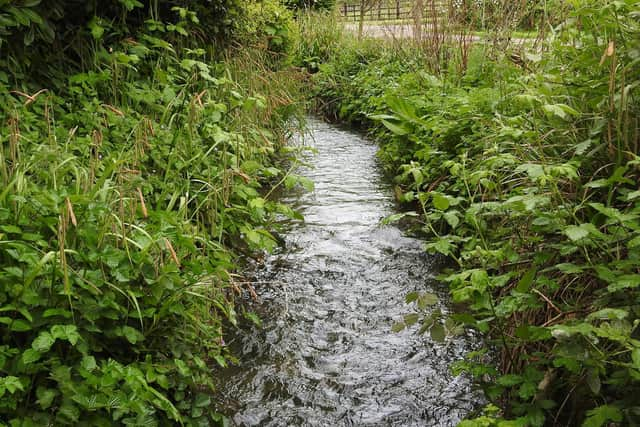
He said: “In the headwaters of the River Rase, just above Market Rasen, we’ve been doing natural flood management.
“This is trying to work with natural processes to reduce flooding. We hold that water in the upper catchment when we get big rainfall events, so we don’t get a big deluge of water all the way through the towns.
“We used to try and get water through towns as quickly as possible, so we had concrete banks to try to increase the capacity in the towns.
“Now we’re trying to hold back the water in the upper catchment so it can spread out in areas where it’s not going to harm properties, slows the flow down so that hopefully it reduces it once it gets to bigger populations.”
Sue Limmer, 65, from Binbrook, was one of the volunteers involved in the Riverfly Survey and tests the chalk stream which flows through Biscathorpe – the River Bain.
She added: “We actually get in the stream with equipment – nets and buckets and stuff – and we do a three minute timed activity of picking stuff out and using the nets to collect a sample which we then empty into a tray.
“Then in that tray, we identify certain riverfly species that indicate the health of the stream and we count the numbers.
“That then gets a score so it can be monitored. If that score changes, it may indicate an environmental issue or something that needs following up.”
Another group that has supported the project is the Aby Fly Fishers, a small fishing syndicate which has helped, which expert guidance, make their stretch of chalk stream improve from moderate to excellent in quality for brown trout. Steve Wood from the group, which always release their catches, said: “We have moved the rainbow trout that had escaped from trout farms, re-stocked it and now just rely on natural breeding.
"We coppice trees to prevent blockages and reduce shading, but also put in logs and heavy branches to narrow the flow and clear out the silt, leaving the gravel for the trout and invertebrates, including mayflies.

"In the 1970s we lost all the greyling from the river. The Environment Agency helps us restock last June and they have grown to eight inches long.”
Mike Drew, biodiversity advisor for Anglian Water, explained that the company provides some of the funding to the partnership, to enable it to carry out its many schemes.
He added: “We want to make sure that what we do is not having an effect on the chalk streams.
“We give over a pot of money each year – some funds to help deliver projects on the ground to restore the chalk streams and take them back to their natural state.”
The LCSP works with a range of 14 organisations including the Environment Agency, Anglian Water, Natural England, Lincolnshire Wolds Countryside Service and local councils across Lincolnshire.
The LCSP has developed a 10-year plan which sets out the need to work collaboratively with local communities and organisations to protect the future of the county’s chalk streams.
The LCSP has spent more than £4.5 million over the last 20 years to benefit the streams and the wildlife that uses them.
A large part of that funding has gone into restoring nearly 19 miles of chalk streams and surrounding land.
The partnership says these chalk streams are important natural habitats and must be properly maintained.
Collette Tait, catchment sensitive farming advisor for Natural England, said: “Our main focus is around water quality, so if we’re working in partnership with other organisations to achieve better water quality, then we can focus on, say, certain catchments to improve our outcomes.
“With the chalk stream project, they invited me to come along and support – because we have access to landowners – we speak to landowners on a regular basis to see if we would invite more people along to join the farm cluster group which was set up on the Upper Bain (flowing through Ludford and flowing south towards Horncastle).”
Steve Jack, manager of the Lincolnshire Wolds Countryside Service said their first project had been on the River Waither at Stainton le Vale, where they re-naturalised the stream after it had been modified and straightened in the past. He said: “We are trying to re-naturalise those streams using natural flood management techniques.” This could be on low-yielding land which farmers are happy to return to wetland or scrapes. “We have had positive engagement with land owners over the years,” he said.
Wildlife attracted to these chalk streams include, brown trout, otter, water voles and kingfisher.
Education and awareness has been a key part of the project, with 2,300 school projects and events where the public can learn more or volunteer to help maintain them.
Mr Jack said: “It has really gone from strength to strength, so we are looking back but also looking forward.”