
Gillian Fisher, ecologist: Lovely Lepidoptera
I have recently been having a lovely lepidopteran time and thought I would write about this here. Now lepidoptera are not big spotty cats but is the group of invertebrates which includes moths and butterflies.
This year seems to be a good year for butterflies, possibly because there was no heavy rain to wash caterpillars off their food plants earlier in the Spring, but for me it has been an especially spectacular year for a set of woodland butterflies I had not yet seen in any number (if at all), on Revesby Estate before.
The Purple Hairstreak butterfly is about the size of a 20p and has a stealth mode that would be the envy of the invisible man, when they are perched in the tree. If you didn’t actually see them land (and sometimes even if you do) they are seemingly impossible to spot. They mostly perch with their wings closed and only the subtle colours of the underwing can be seen.
The underwings are grey, with fine white lines (the ‘hairstreak’ stripe they are named after) and some small orange spots on the outer edge of the lower wing (also known as the hindwing). There are also two tiny ‘tails’ on each hindwing in both males and females. The male, when he opens his wings, has a lovely dark purple colouration over most of his wings.

This is most obvious when the butterfly is in sunlight, and may be invisible when in shade. The female also has purple on the wing, but this is restricted to some stripes at the base of the upper wing (or forewing). These butterflies need oak trees for their caterpillars and spend most of their time around oak trees. They feed primarily on the honeydew secretions of aphids, and so may go searching for these on other trees too.
The way to spot these butterflies is to go out in the late afternoon or even well into the evening, and watch an oak tree. If they are present, you will notice little aerial dogfights going on as the males battle it out or patrols around and around the edge of the canopy. This butterfly is doing well and seems to be increasing in range and number in the UK, indeed I saw them on almost every oak tree I looked at locally! Well over a hundred adults counted (or should I say I lost count after 100).
The White Admiral is a relatively large butterfly, similar in size to the peacock butterfly you may be more familiar with. Both males and females are dark on the upper side of their wings with a broad white stripe and white spots which are obvious even at quite a distance. The underside of the wings are a gorgeous russet colour, oranges and browns with grey at the base of the wings and a white stripe clearly evident here too. The males and females look very much alike. These butterflies need mature woodland with sunny glades and large or numerous patches of bramble. They lay their eggs on honeysuckle and need many flowers for nectar as adults. Sadly this striking butterfly is in decline with a decline of -60% between 1976 and 2019.
Silver-washed fritillaries are large, bigger than the biggest cabbage white (I will write about the white butterflies next month – cabbage whites are actually several different species!) you have seen. The males are such a bright orange colour they almost glow in the sunshine and they may catch your eye at quite a distance. Their colour and patterning resemble the much smaller Comma butterfly which is active at a similar time of year thought they lack the raggedy ‘scalloped’ edge shape that the comma butterfly has.
The female is a slightly less luminous orange but is still a large and striking butterfly. She will lay her eggs on the north or west side of tree trunks low to the ground either within mossy areas or onto the crevices of the bark. Smooth barked trees are avoided. When the caterpillar hatches it immediately crawls into a crevice in the bark and straight away goes into hibernation and will stay that way until the spring. In the spring, they drop to the ground and go searching for violets (especially the common dog-violet) to eat and sunshine to bask in. Usually the adult female will have selected trees in proximity to the flowers.
Their need for both mature broadleaved woodland (with plenty of oak) and violets can make them vulnerable. Muntjac deer in particular will readily eat violets and where it is sunny enough, bramble and grasses can shade out the violets. Silver-washed fritillaries have been in decline during the 20th century but have noticeably spread their distribution north in recent decades.
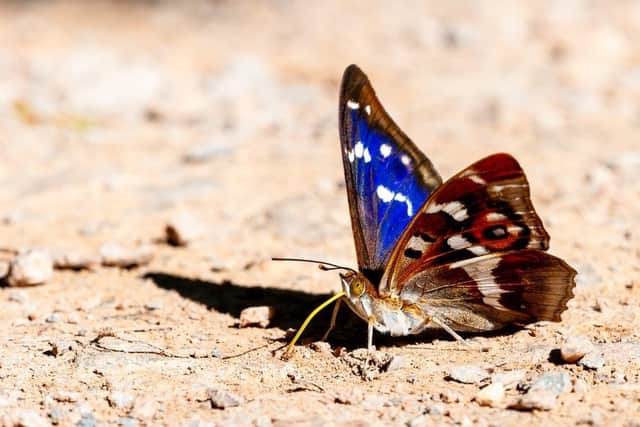
Now last but certainly not least is the Purple Emperor butterfly. This glamorous butterfly is large, really only beaten in size by the more famous Swallowtail butterfly. The males have a beautiful purple sheen across the upper side of their wings and like the purple hairstreak this is most evident when it catches the light. Like the white admiral the wings also have a broad white stripe and some white spots. Indeed the female which lacks the purple colour may at first be confused with a white admiral. However, Purple Emperors have an orange and black ‘eye-spot’ at the lower edge of the hindwings and also on the underside of the forewing.
The eye-spot on the underwing may be hidden when a perched butterfly has fully closed it’s wings and the colours otherwise are similar to white admiral with a white stripe and brown colouration. However, the Purple emperor’s colours are cleaner and less spotted with broader white patches and more grey colouration. Purple emperors need goat willow or grey willow for their caterpillars and so may be strongly associated with scrubby or wet woodland but this must be in the vicinity of mature oak woodland.
Male butterflies will gather around a specific tall oak tree known as the ’master tree’ year after year to display and butterflies will fly quite some distance to this tree for courtship and if you are lucky you may see the butterflies gliding around the top of this tree for many days. Late mornings they sometimes comes down to bramble flowers to feed and also to seek out salts in the soil, from brick walls or in droppings left by larger animals.
Caterpillars almost resemble a slug with two ‘horns’ on their head and at first they are bright green to blend in with the willow leaves they eat. The attach themselves to the leaf base with silk and are most active at night (when they many be spotted with a UV torch!). They overwinter out on the twigs in hibernation before resuming their feeding the following summer.
These four woodland butterflies are visible as adults for a matter of days each year and so if you want to see them you are going to have to be quick, or you can make a note in your calendar to start looking again towards the end of next June (as I have!).
Gillian Fisher, Ecologist