
Exact times in Lincolnshire to see the best solar eclipse since 1999
With the best chance of seeing a solar eclipse since 1999 on the horizon, here’s everything you need to know to make the most of the astronomical event across Lincolnshire.
Residents and visitors across the county will have a chance to witness a rare solar eclipse tomorrow (Wednesday) as the Moon moves between the Sun and the Earth.
During this ‘deep partial eclipse’, between 90-96% of the sun will be covered by the Moon for the first time in 26 years.
The amount of coverage you'll see depends on your location within the UK, and on localised cloud cover.
After this week's event, the UK will not see another deep partial solar eclipse until 2050, while the next total solar eclipse visible from the UK is not due until 2090.
Here in the UK, the eclipse will take place on Wednesday evening (August 12) between 6.17pm and 8.06pm.
In Skegness, Boston, Horncastle, Sleaford, Mablethorpe and Lincoln areas, those with their eyes to the skies will notice the ‘first contact’ just after 6.14pm.
In Louth, Market Rasen and Gainsborough areas, this will occur just before 6.14pm.
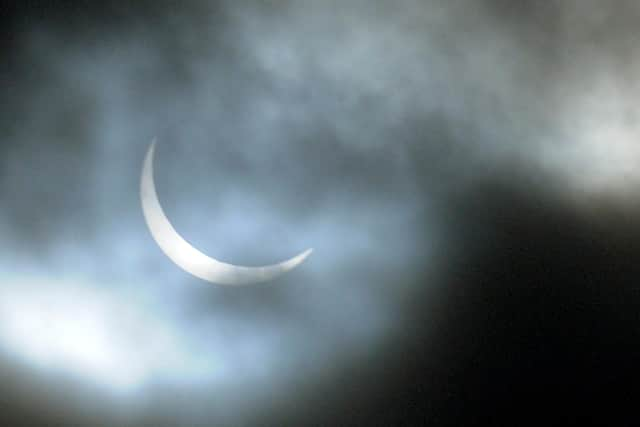

The eclipse will reach its maximum at 7.10pm, when roughly 90% of the sun is covered. At this time, the Sun will be positioned low in the western/north-northwestern sky at an altitude of roughly 12° to 14° above the horizon.
This means sky watchers in Lincolnshire should position themselves in a spot with a clear view of the horizon close to sunset.
At the maximum, enough of the Sun will be covered to make a noticeable difference in the temperature and light levels. However, unlike with a total eclipse, the sky will not become dark. It will feel more like a cloudy day or close to dusk or dawn, according to Royal Museums Greenwich.
How to see the eclipse safely
Ordinary sunglasses don’t provide adequate protection for watching a solar eclipse. Sunglasses reduce glare, but still allow harmful solar radiation to reach the retina.
There are two safe ways to watch a solar eclipse:
• Eclipse glasses. If using these glasses or handheld solar viewers, make sure they are genuine with specially designed filters that meet the international safety standard ISO 12312-2:2015(E).
• You can watch the eclipse indirectly by using a homemade pinhole viewer, viewing the Sun's image projected through a colander or the gaps between tree leaves or projecting the Sun's image onto a sheet of paper.