
How project in tiny village near Gainsborough could make history using power of stars
“If we are the first people to do fusion here in West Burton, it will go down in history for hundreds and thousands of years. It is game-changing for the human race and, potentially, the planet we live on,” said Professor Howard Wilson, director of science and technology at STEP Fusion.
The very elements that make up humans – the carbon in our cells, the oxygen that we breathe, and the iron in our blood – were formed billions of years ago in the hearts of long-dead stars, and these ingredients were scattered across the universe upon their deaths.
These heavier elements that comprise us today formed through what’s known as nuclear fusion, through which the nuclei (the centre of an atom) of lighter elements, such as hydrogen, are forced together and fused.
Not only did this process lay the foundation for life, it is also the cosmic engine that powers the stars, from which vast amounts of energy is produced.
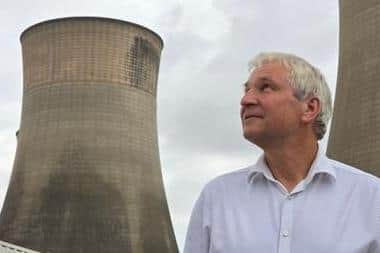

On the site of the decommissioned coal power station in West Burton, a small village nestled at the farthest reaches of north-east Nottinghamshire, some of the brightest minds are attempting to build a power plant that utilises this very same reaction.
If successful, Prof Wilson says it will become an “energy solution for the world”, providing the blueprint for near self-sustaining power for decades to come.
The problem? A commercial fusion power plant has never before existed.
“Fusion energy is the process that powers all stars, and indeed our own star, the Sun,” said Prof Wilson, speaking to the Local Democracy Reporting Service (LDRS) from a makeshift office block at West Burton, which was decommissioned in 2023 after 57 years of operation.
“We know it works, we know it shines, we know we get energy out of the Sun. The challenge is how we recreate those conditions here on Earth.
“Those conditions include achieving a temperature that is actually 10 times the temperature of the Sun.
“The Sun is a fusion powerplant, it is producing fusion energy, but it is a really inefficient one. It is bubbling away, burning very slowly. Which is good, because it means it is still burning today – but, actually, we need something that will create a much higher energy density here on Earth.”
Remarkably, these conditions have been achieved before.
In the Oxfordshire countryside, a doughnut-shaped fusion reactor called JET (Joint European Torus) was built, within which temperatures hit 150 million degrees celsius – the hottest in our solar system.
It was decommissioned in 2023 after 40 years of research, but it helped pave the way for future developments and growing confidence in fusion energy.
The programme in West Burton, which now has the backing of the UK Government, will create similar conditions in what’s called a spherical tokamak – effectively a fusion reactor that looks like a cored apple.
Hence the name of the programme: Spherical Tokamak for Energy Production (STEP).
If all goes to plan, Prof Wilson says it is hoped STEP will produce 100 megawatts (MW) of power – roughly enough to light up a town of 70,000 to 100,000 homes – by 2040.
This will be proof enough that the prototype fusion plant works, and development will then commence to create a commercial fleet from the 2050s onwards.
‘A really fancy kettle’
Prof Wilson trivialises the fusion power plant as, in his words, “a really fancy kettle”.
Effectively, heat generated by the fusion reactor will be used to create steam and drive a turbine, which then generates electricity for the grid.
However, the science and engineering behind the machine is nothing short of extraordinary.
It differs from nuclear fission in that rather than splitting the atom of a heavy element like uranium, fusion squeezes two elements together.
These elements are deuterium and tritium, which are isotopes of hydrogen – in effect, different and heavier forms of what is the most abundant element in the universe.
Prof Wilson says these are heated using some of the most powerful microwave systems in the world – 100 in all – which provides the very conditions that allow their nuclei to touch.
“As they touch each other they will fuse, hence the name fusion, to create another element called helium, which is a bit heavier, and release a lot of energy in the process,” Prof Wilson said.
“It is that energy we are looking to harness. How do we harness it? Well, it is actually two particles that are produced in the process: the helium and what’s called a neutron.
“That neutron comes flying out of the centre of the chamber, and gets caught in a blanket, it heats that blanket up, and we take that heat, create steam, and drive turbines to create electricity.”
The conditions required to allow for fusion creates a plasma in the machine.
Plasma is the fourth state of matter after solid, liquid, and gas.
A simple container would just melt under the extreme temperatures required to hold a plasma, and therefore the reactor uses magnetic fields to hold it in place – a barrier that is invisible to the human eye.
The machine is therefore known as a “magnetic confinement reactor”.
‘The temperature required is not the challenge’
While extreme, the temperatures required is not the challenge, Prof Wilson says – far too calmly for a man about to describe what sounds like science fiction.
The first hurdle is creating enough microwave guns – called gyrotrons – needed to initially heat the reactor.
Each microwave gun will produce one million watts. For comparison, a kitchen microwave produces about 800 watts.
Only a few firms in the world make these, and they can take years at a time to produce.
It is hoped the programme at West Burton will create home-grown talent in the development of these systems, which could then be deployed the world over.
The next challenge is producing a “blanket” that can catch the neutrons as they fly out of the reactor at roughly 51,000 to 52,000 kilometres per second – around 17 per cent of the speed of light.
While the helium is charged, and thus trapped in the magnetic field in the reactor, keeping it self-sustainably hot, the neutron must create the heat required to generate the power.
No one has created a blanket viable for this process – yet.
The third challenge is the production of tritium.
Deuterium is bountiful, and found in seawater, but tritium is very, very rare.
However, Prof Wilson says the solution for this problem lies in this special blanket too – and this is what currently sets the UK’s plans apart from much of the world, including the ITER fusion project in France.
“If you also put lithium into the blanket, there is another nuclear reaction between the neutron and the lithium which creates tritium,” he says.
“So this neutron comes out, reacts with the lithium in the blanket, and creates the tritium.
“You have to get the tritium out, make it into frozen pellets, and fire those pellets back into the plasma to keep the reaction going. You get this closed loop. That blanket is one of the big engineering challenges we have.”
Then, another mind-boggling bit of tech, called a neutron multiplier, is required to make sure more tritium is created than that which is burned – creating a self-sustaining system.
In theory, a person’s entire lifetime energy needs would sit in one bathtub full of seawater and one to two laptop batteries’ worth of lithium.
‘If anything goes wrong…it just goes out’
And, if it all goes wrong?
Not much, Prof Wilson quips.
“If anything goes wrong, then it just goes out. It is an inherently safe process. You cannot get a runaway reaction.”
This danger-free, environmentally-friendly star power has the potential to change the world forever.
The commercial fusion industry is expected to be worth between £3 trillion and £12 trillion by the end of the century – and Nottinghamshire is right at the forefront of this new frontier.
Prof Wilson added: “It is important because we, humans, are using more electricity, even here in the UK with our big data centres and electric vehicles require more electricity.
“Emerging economies around the world are using more power, in places like India and Africa, and emerging nations, who absolutely have the right to enjoy the same lifestyles we enjoy. But it will take energy.
“But where does that energy come from? A sustainable way that doesn’t contribute to global warming and climate change.”