
Wheelchair-bound RAF veteran is now fighting for a suitable home in West Lindsey
A wheelchair-bound RAF veteran says he feels let down by how difficult it has been to get housing in West Lindsey after serving his country.
Stuart Bunyan, a 47-year-old former aircraft engineer, was medically discharged after a workplace accident.
He says the two-storey home he has been allocated by West Lindsey District Council would be impossible for him to navigate, and he wouldn’t be able to go upstairs to his children.
He has been trying to challenge the decision in court, and says he thought he would get better treatment as a veteran.
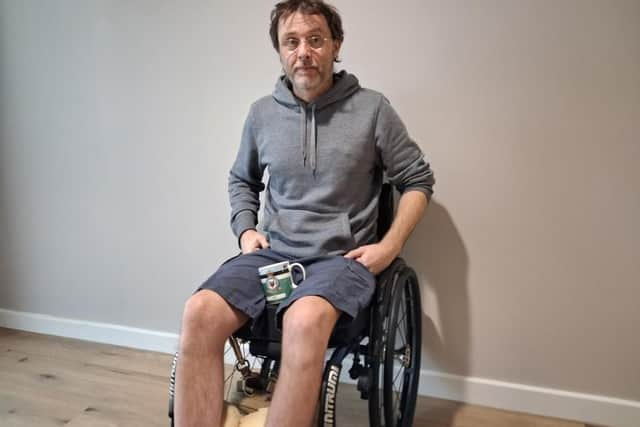

“No one would end up going into the military if they knew this would be how you get treated once you’re out,” he told the Local Democracy Reporting Service.
“My experience since leaving the RAF has been one of constant uncertainty, repeated requests for assistance, temporary accommodation and legal disputes.
“We have repeatedly explained the difficulties we face and the impact that the housing situation has had on my health and my family. Despite all of this, we remain without a permanent suitable home.”
Stuart served in the RAF for 12 years, being posted at bases across the UK and Cyprus, and working on VC10s and Tornados.

His career came to an end after an accident and unsuccessful surgery that left him unable to walk, withsevere chronic pain and complex neurological problems.
He first alerted the council in 2021 that he would become homeless, when he was living in RAF Scampton’s family quarters with his wife and two teenage children.
He was told to bid on available council homes but said he couldn’t find any that would be suitable for his needs.
When he was evicted by the Ministry of Defence in 2025, the family was placed by the council in a Travelodge for six months, and then into two separate flats in temporary accommodation.
In March 2026, he says the council offered them a two-storey house in Nettleham which they proposed adapting to Stuart’s needs.
However, Stuart believes he wouldn’t be able to move around safely or navigate through narrow doorways and corridors.
“My wheelchair requires sufficient circulation and turning space. I cannot simply stand up, move my feet or step around an obstruction,” he said.
“The council’s approach appears to be that we should make compromises, including changing furniture we already own to smaller items, to accommodate my wheelchair within the available space.
“I find this particularly difficult to accept. Why should my family have to sacrifice ordinary living space and essential household equipment because I am disabled?”
He and his wife, who is his constant carer, have tried to map various ways of laying the house out, but don’t believe any would work.
The prospect of not being able to see his children’s bedrooms also concerns Stuart, who said: “I may be disabled, but I am still their father.
“My children should not have to come downstairs every time they want my help, reassurance or support.
“My ability to participate in family life should not be treated as unnecessary simply because I use a wheelchair.”
Stuart, who is currently living in a care facility in Welton, appealed the housing decision through a Section 202 review, which the council turned down, saying the property was suitable. He is now attempting to challenge it in county court, with the case currently ongoing.
He feels that society hasn’t lived up to the Armed Forces Covenant, which says that ex-service members shouldn’t be disadvantaged and extra support should be provided to those who need it.
“As a husband and father, it is extremely difficult knowing how much my family has had to endure because of my disability and our inability to secure suitable accommodation,” he said.
“We have done everything we reasonably could to prevent this situation.
“We approached the council before my discharge, supplied evidence, attended meetings and property viewings, raised concerns and followed the formal procedures available to us.
“Yet nearly five years after first asking for help, we are still fighting for a suitable home.”
A spokesperson for the council said: “Whilst we do not comment on individual cases, our teams work tirelessly to support families facing challenging circumstances, ensuring they receive the most suitable accommodation available at their time of need.
“We take our housing responsibilities extremely seriously, and the whole team is working hard to identify a long-term solution for this family. This is a particularly complex case, and our colleagues and partners are collaborating closely with the family to progress options as quickly as possible.
“Our teams are deeply committed and have already done a tremendous amount of work to support this family. We remain in regular contact with those we support and continue to provide ongoing assistance to make sure their needs are met.”