
Lincolnshire Police chief constable hopeful that neighbourhood policing will increase
The chief constable of Lincolnshire Police has said that he remains hopeful that recently-cut neighbourhood policing will increase again following additional government funding.
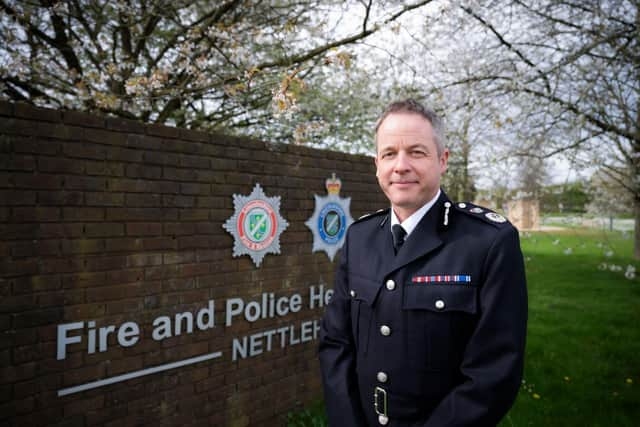
Paul Gibson told members of the Lincolnshire Police and Crime Panel that an additional £12 million funding package from the government will mean that the force will now be able to recruit more neighbourhood police officers and PCSOs (Police Community Support Officers).
Lincolnshire Police announced in December that it would be taking about 50 officers from their existing duties and moving them onto emergency matters in response to financial and staffing pressures, as part of a six month trial.
These officers have been moved off neighbourhood, road and rural teams and put into the response team, the Criminal Investigation Department (CID) and the Protecting Vulnerable Persons (PVP) teams to ensure that the force deals with incidents which pose the most immediate threat and harm to the public.

This comes after a cut to PCSOs in 2023, where the number of such officers in Lincolnshire was reduced from around 95 to 50. This has since fallen further to 30.
But Mr Gibson said that he remains optimistic that neighbourhood policing will improve in the near future.
At a meeting on Friday, February 6, Coun Phil Dilks (Independent), who sits on both Lincolnshire County Council and South Kesteven District Council, said he was “pleased” if there were plans to put more officers back into neighbourhood policing, but warned that some parts of the county would suffer until the changes come into effect.
He said: “We are particularly concerned about the cuts you announced to neighbourhood policing.
“I understand you had to ‘shift the deckchairs around’ some way or another, but we’re particularly concerned at the lack of support that we now have come to expect in council business.
“For example, just a couple of weeks ago (in South Kesteven) we had an incident involving waste on some land and we needed police support to go and enforce some action.
“That was forthcoming but the officers said ‘this is the last time you’ll see us because we’re being moved’.
“That’s only one thing, but we’re also worried about the anti-social behaviour and a whole raft of other things frankly which impact just on council business, never mind neighbourhood policing that affects residents right across our rural areas.”
Mr Gibson explained: “So, in terms of PCSOs and neighbourhood policing, from my perspective, I’m a massive supporter.
“In our discussions with the Home Office, we did try to seek extra finances in order to support quite a significant growth in neighbourhood policing.
“From the perspective of supporting PCSOs and principles of neighbourhood policing, I one hundred per cent support it.
“In terms of the temporary reductions, we’ve called it a glide path. They are decisions that I never wanted to take, but unfortunately have come out of the funding situation and our legal requirements to be able to balance the budget.
“As a result of that, as we’ve talked through, the pipeline for police officer recruitment has fallen away and that has led to the glide path downwards of numbers of police officers, police staff, although we’ve retained our numbers of 30 PCSOs.”
The chief constable went on to say that he too would like to return to previous levels of PCSOs, stating: “I agree with you, it used to be 149, if I could afford 149 or more, I would gladly invest. The glide path issue essentially means that our lowest is in May this year.
“So that’s where we are around 25 per cent under in deployable officers. That’s not just numbers, that’s deployable officers.”
But Mr Gibson went on to say that he remained hopeful that the situation will begin to improve for police teams over the next few months.
He added: “We’ll have nearly 100 officers in training but they have to go through training, they have to then be tutored and it takes time to essentially get them into a deployable position so they’re ready to serve the public fully.
“In terms of the glide path, we’ve moved 65 officers and they have been moved to support response policing – we can’t not respond – to public protection – we cannot not investigate the most horrendous crimes against children – and also to investigation functions, so the Criminal Investigation (CID) Department.
“Now those moves are temporary. The moves have come from, as you say, neighbourhood policing, from our rural crime team, from some of our search teams which are not big and also our roads police which are not big.
“But it’s a needs must. There was no other alternative. Actually, the 65 officers have volunteered and the really important point to make is that there’s been no team that’s been removed.
“We’ve retained a skeleton staffing within rural crime, neighbourhood policing, search capacity, and the intention is to replenish those teams as soon as we possibly can.”