
Boston secondary school 'no longer requires special measures', but 'more work needed', Ofsted says
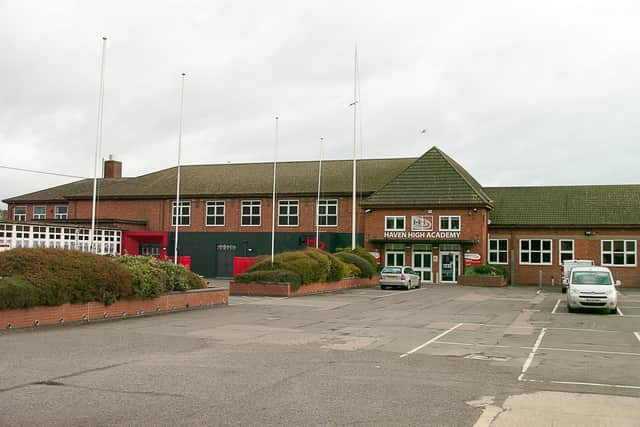
A secondary school in Boston ‘no longer requires special measures’, but ‘there is still more work needed to raise standards’, Ofsted has said.
The education watchdog published its latest inspection report of Haven High Academy today (Monday, September 21).
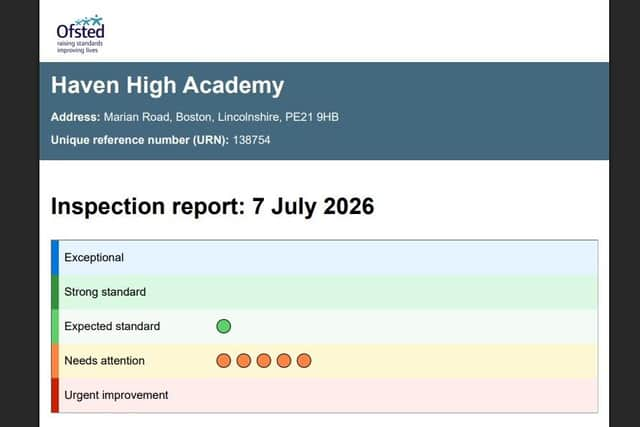
Ofsted no longer gives an overall judgment for schools, such as ‘outstanding’ or ‘inadequate’. Instead, it publishes ‘report cards’, with grades awarded in different areas. These grades, in descending order, are: ‘exceptional’, ‘strong standard’, ‘expected standard’, ‘needs attention’ and ‘urgent improvement’.
Following its inspection in July, Haven High was awarded ‘expected standard’ in one area (personal development and wellbeing) and ‘attention needed’ in the other five areas (achievement, attendance and behaviour, curriculum and teaching, inclusion, leadership and governance).

However, in addition to this, the report also notes that His Majesty’s Chief Inspector is ‘of the opinion that the school no longer requires special measures’, a status it has held since 2024.
Under personal development and wellbeing, the strongest area, comments include:
- “Leaders have designed a broad and interesting personal development programme that prepares pupils well for adulthood and for their lives in modern Britain.”
- “Leaders are alert to any pupils who are vulnerable or who face challenges to their wellbeing. Pupils value the support that is provided and know that there is always somebody they can talk to when they are worried.”
The rest of the report gives a more mixed picture; when something is praised, often shortcomings are also identified. Words such as ‘inconsistent’ and ‘varies’ crop up a fair bit.
Under achievement:
- “Pupils’ achievement across the curriculum is inconsistent. At times, gaps in prior learning and weaknesses in basic skills are not corrected. This means that pupils struggle to connect new knowledge and learning is insecure. Sometimes, expectations of the quality of work that pupils can produce are not high enough.”
- “In subjects where the curriculum is well-designed, and in classrooms where teaching is of high quality, pupils gain knowledge securely. When teachers’ expectations are high, pupils rise to the challenge and produce work of high quality.”
Under attendance and behaviour:
- “Despite some improvements, a minority of pupils do not behave as well as they should. They disrupt learning and negatively affect other pupils’ enjoyment of school. While the school has high expectations of all pupils’ behaviour, there is some inconsistency in the way that poor behaviour is challenged and addressed.”
- “On the other hand, the majority of pupils have positive attitudes to learning. They follow rules and routines without fuss and enjoy positive relationships with peers and staff. Classrooms are typically calm. (...) Staff do not tolerate bullying or discrimination. Any incidents are taken seriously and resolved quickly.”
Under curriculum and teaching:
- “The quality of teaching varies. Sometimes, teachers do not check pupils’ understanding carefully enough. This means that they do not identify pupils’ starting points or gaps in pupils’ prior learning accurately. At times, there is a lack of clarity about what pupils should learn. (...) Teachers do not apply planned strategies consistently to support pupils to overcome barriers to learning. Sometimes, pupils with special educational needs and/or disabilities do not get the support they need to succeed.”
- “The school has introduced systems to identify when pupils have gaps in basic skills, such as reading, writing and numeracy. Leaders have begun to plan and deliver support so that pupils catch up. This has been particularly impactful in helping pupils to gain fluency and confidence in reading. However, there is not sufficient focus on supporting pupils to strengthen these basic skills across the curriculum.”
Under inclusion:
- “Planned strategies to support pupils to overcome barriers to learning are not implemented consistently across the school. The school has effective systems in place to identify when pupils have special educational needs and/or disabilities (SEND), or when pupils face barriers to learning or wellbeing. Leaders work closely with pupils, and their families, to put plans in place to ensure that these pupils’ needs are met. These plans are shared with staff but there is variation in how well they are applied in the classroom. Leaders recognise this. They have begun an ambitious programme of professional learning to make sure that teaching meets the needs of all pupils.”
Under leadership and governance:
- “After a turbulent past, the school’s leadership has strengthened and stabilised. This has brought about significant improvements. However, there is still more work needed to raise standards and to make sure that pupils leave the school with the knowledge and qualifications they need to be successful in their next stages of education, training or employment.”
- Ambitious and determined leaders have absolute clarity about their priorities for improving the school. Their work has been impactful. For example, leaders have improved attendance and behaviour. They have redesigned the curriculum and are working to strengthen its implementation.”
Ofsted also found that safeguarding standards are met.
Executive headteacher Austin Sheppard said: “I am incredibly proud that Ofsted has recognised the significant progress made at Haven High and that the academy is no longer in special measures.
“This is testament to the hard work, commitment and determination of our staff and students, with real improvements recognised in leadership, behaviour and the quality of education.
“We know there is more to do, but this is an important milestone and we are determined to build on this progress as we continue our journey towards providing an exceptional education for every student.”