
COLUMN: Finding links to the 19th and 20th century in a 13th century setting
As part of an ongoing restoration and redevelopment of Greyfriars, in Broadgate, Lincoln – being delivered in partnership by Heritage Lincolnshire and the City of Lincoln Council to reopen this 800-year-old building to the public – a number of fascinating historic discoveries have been uncovered.
These finds are providing valuable new insights into the site's rich and complex history, says Heritage Lincolnshire in introduction to this week’s column ...
Although the Greyfriars building dates back to around the 13th century, many of the recovered artefacts date to the 19th to 20th century – including glass bottles and corks relating to the brewery industry.
Some of the bottles are embossed with ‘Arnold & Co. Lincoln Ltd’ and ‘Batey & Co.’, a London firm.
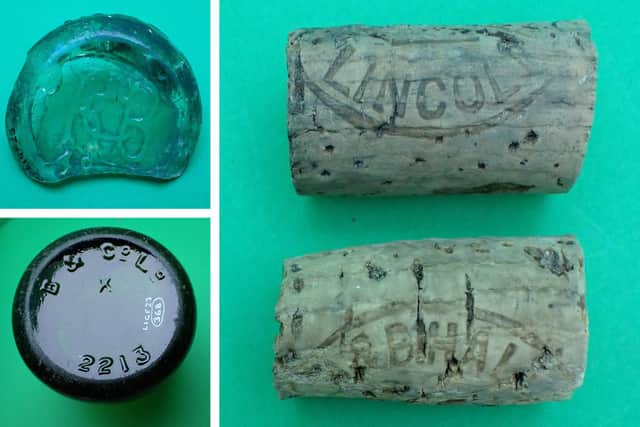

Frank Arnold was a grocer with premises at 281 High Street, Lincoln. He became an agent for Bass & Co., of Burton on Trent, in around 1867, bottling their ales and using bottles embossed with his own logo. A decade later, he was also bottling for the Guinness company.
After his death in 1888, the business passed to his son (also named Frank). He diversified into manufacturing mineral water, acquiring the Lincoln Aerated Water Co., which really helped to expand the business, opening offices on Clasketgate, and later on Rumbold Street. He died in February 1905, aged 48, being one of the first victims of the typhoid outbreak.
The company later merged with local firm Park & White, to become Park, White and Arnold Ltd.
They carried on trading until around 1961, after which the company closed.
We also have several corks, embossed with ‘A&B HALL LINCOLN’ – Arthur & Bertram Hall Ltd., of the Forehill Brewery, in Ely. The brewery was built in 1869-1871 and was then acquired by William Henry Brook’s Crown Brewery, of Lincoln, in 1892.
After several mergers over the years, in 1957 it was acquired by Steward & Patteson Ltd. It closed in early 1969, but during its lifetime owned 97 pubs, 28 of which were in Lincolnshire. Fifteen of these (of which six are still operational) were in Lincoln.
This column has been provided by Denise Buckley, project officer for Heritage Lincolnshire’s Archaeological Project Services