
Definitive speech tells story of saga to restore collapsed Horncastle village church
A saga, spanning almost six years, to restore a partially collapsed church in the Horncastle area, is on target for a glorious conclusion.
Now a definitive summary of the journey completed by the villagers of High Toynton has been committed to paper and delivered in a landmark speech.
Here we reproduce the talk, which was written and given by Alison Bell, secretary of the local parochial church council, which has spearheaded the restoration work at St John The Baptist Church.
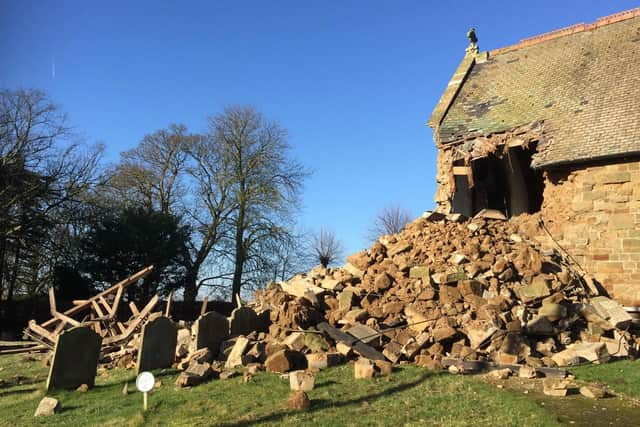
In January 2020, the tower at the church crumbled, forcing the historic church to close its doors. Complex plans to repair the Victorian structure were priced at more than £300,000 and labelled ‘mission impossible’.


But thanks to a grant from the National Lottery Heritage Fund, tireless fundraising work by the High Toynton community and the support of businesses, light is at the end of the tunnel.
The church’s lighting and heating should be ready for a poignant Christmas carol service at the church on Saturday, December 20.
And once the floor is restored and a servery installed, the church, on Gravel Pit Lane, off Tetford Road, will be all set for a choral service of re-dedication, attended by the Bishop of Lincoln, on Sunday, May 10 next year.
Alison says: “Our journey towards opening our restored church as a community space has been one of tremendous creative energy and positive input.” Here is her speech:
"It’s 10.30 on a quiet Sunday morning, January 19, 2020. Cloudless blue sky and sharp frost.
"Telephone rings. It’s my cousin who lives over the road. ‘Have you seen the church lately?’ I am asked.
“I glance out of the window desultorily and I am suddenly focused and startled. The church is there but the tower, a local landmark for 150 years, is nowhere to be seen.
“Within the hour, we had three fire engines on site, villagers milling around in the lane, multitudes of men in hard hats and hi-vis jackets, police with sniffer dogs (searching for bodies in the rubble!), the vicar and, by the following day, councillors, journalists, structural engineers and stonemasons.
"East Lindsey District Council (ELDC) lost no time in slapping a ‘Section 78’ on us, making it our responsibility to ensure the safety of the building.
"In monetary terms, this worked out eventually at £32,000, payable within the month, although of course we had no idea of that initially.
"Because of the drama, we were given extremely good media coverage, both locally and wider afield. The ‘Daily Telegraph’ even published a fascinating shot taken from the air.
"All of this and the generosity of mainly local people helped us to raise £12,000. Villagers raised loans of £16,000, most of which have still to be paid back.
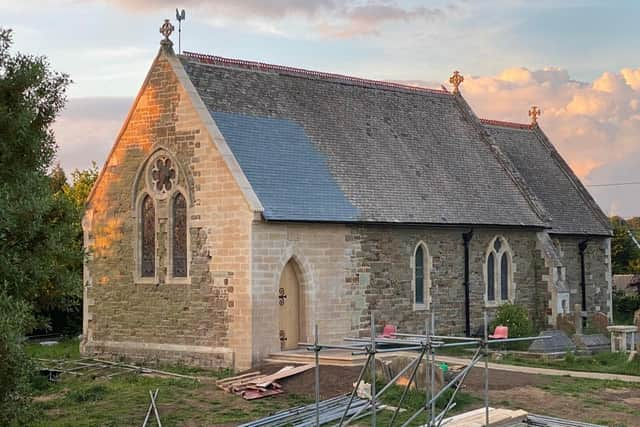
"Somehow the funds were raised to pay for a quantity of scaffolding both inside as well as outside the church, along with corrugated hoardings which formed a security compound around the site. And we sat back to take a breath and think….what now?!
“What actually happened next was lockdown. We didn't see the architect until the September. Although we looked into funding and grants, nothing really got going until in 2021 when Charles Patrick, our wonderful vicar, suggested, in his modest way, that he introduce us to his brother John who, it transpired, was just starting a business as a project manager, having worked with Lincoln Cathedral, organising grants worth millions of pounds.
"We would be the first clients of the new consultancy, Irving Patrick, and from then on, it started happening. Irving Patrick held a meeting with a large percentage of the villagers in the churchyard to brainstorm.
"Seeing the broken church as a clear space, what could we envisage happening within it? To what new uses could we put it? It represented our only community space and, thus, it was crucial to the heart of the village.
“Many suggestions were put forward – from a space to hold craft workshops to one hosting children's groups, as well as a venue for film suppers, concerts and, of course, worship. There could even be a possibility of hiring out the space.
"John Patrick and his associate, Anne Irving, then worked with us to put in an application to the National Lottery Heritage Fund (NLHF). Much to our joyous amazement, we were awarded £225,000 early in 2022.
"We thought this massive amount of money would generously cover what we needed to do and certainly without it, we could never have even started.
“We were assigned a mentor from the NLHF. Unfortunately, she underestimated the amount of work needed in order to take the first step – the removal of the serious pile of rubble. She did not want the project managers involved for what she saw as the simple first step, feeling that we should be capable of achieving this with the help of the diocese and our original architect.
"We were hopelessly at sea and hit the dust six months later when it transpired we had not got the necessary permissions due to misinformation and misunderstandings.
"At that point, we demanded our project managers be reinstated, and we were assigned a different mentor – Joe Moran, along with quantity surveyor Andrew Purcell, whose professional experience has since kept our objectives in focus and progress evaluated.
"Even with all this support, it still took another year before the rubble removal took place in August 2023.
"Professional management understood that this ‘first step’ was to thoroughly comprehend the fragile environment of the churchyard, as well as the materials used in building the tower, so that a picture could be built up as to why the tower collapsed.
"Structural engineers were employed to complete ‘boreholes’ to measure and assess the geology underneath the church and to discover whether voids could have contributed to imbalance and weakness of the tower.
"Archaeologists surveyed the site. There were constant inspections of scaffolding and wildlife-monitoring, including for bats and bees, and conservation experts inspected and sorted the rubble when it was finally moved.
"All these professionals had to be engaged through job advertisements, job specifications, tenders and contracts, along with sorting the necessary faculties and planning applications. It was eventually established that the collapse was due mainly to the poor building materials used in the tower.
“Having given all this into the capable hands of Anne and John, what was the job of the village?
"A village is made up of different people with diverse skills. Mick Gill and Jeff Jones used their business skills to gain two separate grants from ELDC which gave necessary support to the NLHF funding. Pearl Davis took on the post of treasurer. Rob Tomkinson set up a Just Giving site, designed a website and introduced us to Facebook, while David Bell gave us the use of a paddock for summer events, along with a large marquee.
"These and many others in the village have worked to facilitate a vast range of events that have maintained our high profile, keeping up enthusiasm to hold us in the public eye and give our community spirit credibility in the eyes of our funders. Bearing in mind this is a small village with only 60 residents all told, it has often added up to a lot of cooking!
“During Covid, a group of us painted a series of eight feet by four feet boards with a timeline of village history that we mounted on the hoardings. This put a positive slant on the broken aspect of the church and displayed our faith that we would rise again. We were successfully interviewed not only for radio but also for TV.
"In September 2023, among other events, we held a poetry festival on the theme of ‘Collapse And Renewal’, which resulted in a whole booklet of local people's poems.
"Through 2024, we put on at least eight events, most of them in the paddock, ending with a tremendous music festival. This was followed by the launch of our village CD, composed by Tom Lane, commemorating High Toynton Church and village life, at a crowded ceilidh in Horncastle. Tom, a well-known Lincolnshire musician, and his talented group of friends performed many of the songs to great applause.
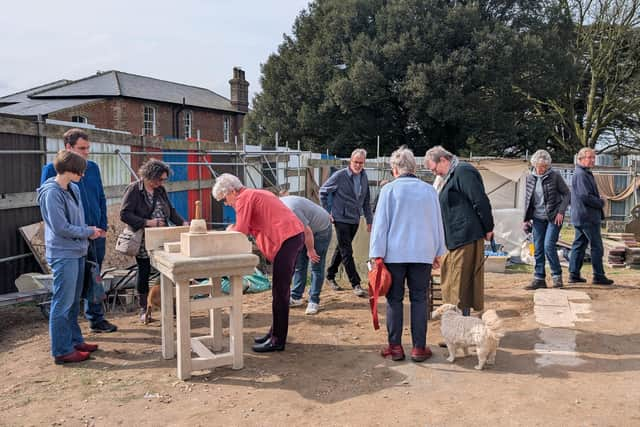
"In the spring of 2025, a day of thanks for the National Lottery that showcased the skills of the stonemasons, who had by then been on site for nearly six months, drew crowds that arrived an hour early and certainly did not leave on time. The stonemasons in attendance were extremely gratified by the real interest demonstrated.
"Crowds came again in mid-September when the annual music festival was held in the newly-restored church building. Everyone agreed that the acoustics and ambience would ensure that this will be a great performance venue in the future.
“This whole journey has been not just making good a structure. It has also brought into focus what it means to live in a small community. We are a society where people meet informally at least twice a week and, in the future, perhaps more! A small but dynamic cog reaching out to a wider locality.
"The NLHF has also generously awarded us subsequent funds to see this project through to the end. We will never be able to thank them, and our other funders, enough for the opportunity to construct not just our church building but also something full of positive meaning for all our lives.”