
Council leaders react to local government shake-up plan

A Government plan for major expansion of Lincoln’s boundaries has been confirmed, with the surrounding villages to be absorbed into a much bigger council.
The new authority will incorporate nearby parts of North Kesteven and West Lindsey, while the rest of the county will be merged into a separate council.
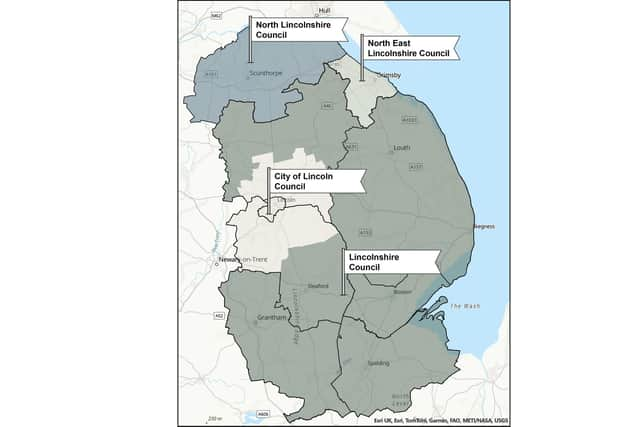

North Lincolnshire and North East Lincolnshire Councils will remain unchanged, with the potential to combine in the future.
The major government reorganisation will abolish Lincolnshire’s eight current county and district tier authorities, in favour of just two which will deliver all services.
From West Lindsey, the new city authority will incorporate the wards of Bardney, Cherry Willingham, Dunholme and Welton, Nettleham, Saxilby, Scampton and Sudbrooke.
In North Kesteven, it will include Bassingham Rural, Bracebridge Heath, Branston, Heighington & Washingborough, Hykeham Central, Hykeham Fosse, Hykeham Memorial, Metheringham Rural, Navenby & Brant Broughton, Skellingthorpe & Eagle, Waddington Rural and Witham St Hughs & Swinderby.
There had been widespread disagreement over which model to opt for, with the City of Lincoln Council’s proposal being chosen over three others.
The county council had fought for a single authority covering the whole of Lincolnshire, although this was criticised as too large and remote.
Other districts had put forward various proposals for how to split Lincolnshire in two without cutting across the current boundaries.
The existing councils will continue operating until May 2027, when elections will be held for the two new authorities.
The ‘shadow’ authorities will then gradually take over until an official switch in April 2028.
In total four distinct proposals were submitted for Government consideration, each suggesting different ways to reorganise council functions for Greater Lincolnshire’s 1.1m residents across 7,000 sq km.
The two new councils create areas of around 208,000 people in an enlarged city area of 816 sq km; and 574,000 people in an area of 5,120 sq km across the rest of Lincolnshire.
The larger Lincoln model had been attacked by neighbouring councillors who said that their residents didn’t want to be absorbed into the city.
However, Lincoln leaders argued that the city’s urban area and its surrounding villages had very different needs to the market towns, countryside and coast in the rest of Lincolnshire.
The government says the new system will be easier to understand and deliver better services for residents.
The Government announced its decision confirming new streamlined councils, “bringing services together under one roof and ensuring taxpayer’s money goes towards the services they want to see”.
The process is expected to create “one stop shops” for residents bringing all council services under one roof – speeding up decisions for vital projects.
Steve Reed, Secretary of State for Housing, Communities & Local Government, said: “This government is serious about creating new councils fit for the future, improving services for residents whilst delivering increased value for their council tax.
“These new authorities mean real change for communities across the country, empowering local people by making it more straightforward to find out about local services, and giving those who know their areas best a stronger voice for change.”
Leader of City of Lincoln Council, Naomi Tweddle, said: “The time has come to overhaul the outdated two-tier council system so we can go further and faster in delivering for our residents.
“The money it will save taxpayers can go towards funding the frontline services we deliver, and it will bring an end to the complex system where one council is in charge of your bins and the other roads.
“For Lincoln, having a unitary authority on a slightly bigger footprint will allow our city to retain its distinct identity as well as reach its potential – it is a great step forward.”
North Kesteven District Council Leader Coun Richard Wright said: “It is the biggest change to local councils for more than 50 years and as you would expect of us, as a community-focused council, we are committed to making it work for all our residents and dedicated to ensuring a seamless transition to a new unitary structure.”
Because a huge amount of work has been going on in the background, alongside ongoing service delivery, in readiness for the decision, councils are well-prepared to move forward with the new arrangements.
A joint statement was released by the South & East Lincolnshire Councils Partnership and the leaders of Boston Borough Council, East Lindsey District Council, South Holland District Council.
They said: “We are committed to maintaining strong relationships with our business community and partner organisations and ensuring that support continues uninterrupted. “Our Economic Development teams remain on hand to provide business advice and guidance, signpost funding and grant opportunities, and connect you with the right organisations through our established networks across the public, private and education sectors. "We have a strong history of working collaboratively with partners across Greater Lincolnshire, and that collaborative approach will continue throughout the Local Government Reorganisation (LGR) process. We will work closely with colleagues across the area to ensure a smooth transition of economic development and business support services, while maintaining continuity and minimising disruption for businesses and partners. “We will continue to keep you informed of key milestones and provide updates as more information becomes available.”
West Lindsey District Council’s Leader, Coun Jackie Brockway said: “We are disappointed by the Government’s decision, particularly because it divides West Lindsey’s traditional boundaries. The Government indicated
that local government reorganisation would be based on existing council boundaries unless there were exceptional circumstances. We do not believe such circumstances exist in this case.
“The population of the new unitary authority which includes the City of Lincoln is significantly below the Government’s initial criteria of 500,000, making it one of the smallest new unitary authority created across the country. This is in stark contrast to the other new unitary authority serving the remaining county of Lincolnshire, which is amongst the largest in both geographical area and population, serving more than 600,000 residents.
“This decision creates greater uncertainty for residents and our employees, so the council must approach the next stage with determination and focus.”
Coun Brockway added: “We are a responsible local authority focused on delivering the best outcomes for residents in West Lindsey and so we will go into this next stage with goodwill and determination to make it work for our residents, businesses and communities. There will be opportunities ahead, and we will ensure that we play a full and positive part in shaping arrangements that are effective, accountable and rooted in the needs of local people.
“At the same time, we must recognise the strength of West Lindsey’s identity and the real concerns that come with the prospect of the district being split. Our role now is to make sure those concerns are properly understood and that the interests of our communities continue to be represented throughout the transition. Our priority is to ensure that residents continue to receive high-quality service delivery, which will remain our central focus.”
The Leader of South Kesteven District Council, Coun Ashley Baxter, said: “While residents will be keen to understand what this means for them, our immediate focus remains on delivering day-to-day services and supporting our workforce as the next stages of the process are worked through.
“South Kesteven District Council will now take time to review the detail of the announcement and understand the implications for our residents, services, staff and businesses.”
Coun Baxter added: “I am naturally disappointed that our proposal was not accepted as the preferred bid.
“We consistently argued that our proposal was the option most likely to retain a meaningful connection between councillors and their residents.
“The decision to go with an expanded City of Lincoln unitary leaves the rest of Lincolnshire with no common ground. Grantham, for example, will now be in the same local authority area as Gainsborough, but not Lincoln.”