
Councillors say joint approach is ‘best for Greater Lincolnshire’
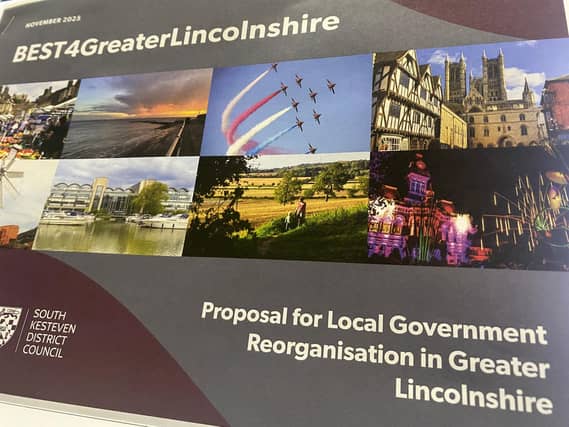

Councillors have supported the joint North and South Kesteven district councils’ proposal for reshaping local government within Greater Lincolnshire, saying it’s the best for the area.
Councillors have supported the joint North and South Kesteven district councils’ proposal for reshaping local government within Greater Lincolnshire, saying it’s the best for the area.
Through two separate meetings held on Thursday, November 20 members of both councils endorsed the approach which – if ultimately backed by Government as its preferred model in its Local Government Reorganisation drive – would see four unitary authorities across the area, each delivering the full range of council functions for their locality.
Two of these would be new unitary councils set up within the Lincolnshire county footprint – one for the areas of North Kesteven, South Kesteven and South Holland; the other covering Lincoln, Boston and both East and West Lindsey. North and North East Lincolnshire councils would continue as they are for now – resulting in four councils for the Greater Lincolnshire area.
Fire and Rescue would still operate on a Lincolnshire-wide basis but other functions that currently sit with the county council would be picked up by the new unitary authorities.
Final decision on submitting the BEST4GreaterLIncolnshire proposal will sit with South Kesteven District Council’s Cabinet meeting on Monday November 24 and North Kesteven District Council’s Executive Board meeting on Thursday, November 27, the day before the submission deadline.
At North Kesteven District Council – where all but one of the 31 Members present endorsed the approach – the councillors felt that it was the ‘best prepared bid’, best for the area and, as its tagline states, the BEST4GreaterLincolnshire.
They felt that it was built on strong evidence and logic, that it was thorough, struck the right balance between local connectivity and achieving effective efficient service delivery, was most pragmatic and ultimately the best for residents.
Seeing it as the ‘most balanced and financially stable’ of the four proposals likely to be submitted by councils within Lincolnshire, Members also highlighted its compliance with the requirements Government had set out, said it strongly met all the expectations of change, was grounded in data and analysis, underpinned by robust financial modelling, responded to 5,500-plus engagement responses that favour councils and delivery structures being as local as possible, and outlined many potential transformational benefits.
Among these benefits are:
- Two equal-sized council areas of similar population and size.
- Of a scale that still enables strong community engagement and builds neighbourhood empowerment.
- Right-sized to achieve efficiencies, improve capacity and withstand financial shocks.
- Keeping local government close to residents rather than pushing it further away.
- Prioritisation of high-quality sustainable service delivery.
- A more-localised scale that balances the efficiencies of size with the accessibility of service delivery.
- A focus on people and place.
- ‘Best-fit’ alignment with economic areas in support of strong local economies and meaningful jobs creation.
- Retention of identity and belonging, highlighted as significantly important by most engagement respondents.
- Strong representation ratios with roughly one councillor per 4,000 electors across each new council area, each covering 42 sq km on average.
- Financial sustainability with net savings of between £24m and £80m by year 5.
- Clear opportunities to transform established patterns of service delivery.
- Natural synergies in demographic profiles across the constituent parts, which simplifies service prioritisation.
- Rigour and confidence in delivering on what’s promised and being fit for the future.
The Council’s general view was that through the BEST4GreaterLincolnshire proposal it was ‘giving this our best shot’.
The decision to endorse it was described by the Chair of Council Cllr Chris Goldson as a ‘watershed moment’ in shaping the future direction of local governance that, within Lincolnshire, was last changed in 1974 when again more smaller councils were reconfigured into fewer larger authorities, but still in a two-tier system.
The changes are driven by Government through the English Devolution White Paper published in December 2024. All councils in Greater Lincolnshire were invited to submit a proposal. It is expected that further suggestions for change will be made by Lincolnshire County Council, City of Lincoln Council and the South East Lincolnshire Councils Partnership, each proposing different approaches. These can all be seen in the Maps & Proposals link at www.n-kesteven.gov.uk/LGR