
'Drastic changes to our rural landscape' - Councillors object against ‘huge’ solar farm application
County councillors are the latest authority to voice strong opposition to a proposal for a large farm between Sleaford and Lincoln.
Fosse Green Energy is a proposed solar farm covering over 3,000 acres near the villages of Thorpe on the Hill, Witham St Hughs, Haddington, Thurlby, Navenby, and Bassingham.
But members of the county council’s Planning and Regulation committee have been vocal in opposition, echoing concerns already raised by North Kesteven District Council planners.
A 10km cable corridor, connecting the site to a proposed new National Grid substation near Navenby, is also included in the application.
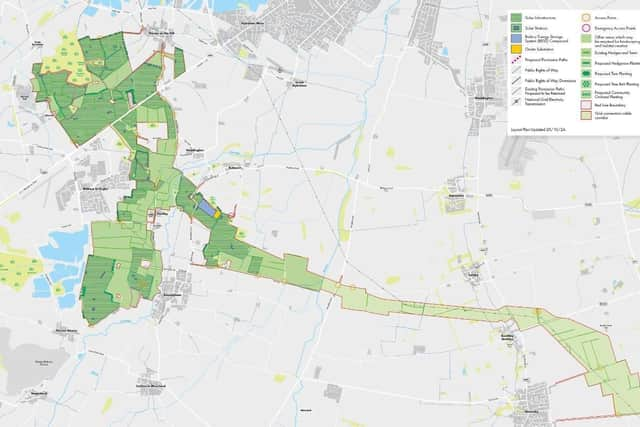

The project is made up of a solar photovoltaic generating station with battery storage, onsite substations and associated infrastructure. The developer, Windel Energy and Recurrent Energy, states this will generate and export/import electricity in excess of 50MW, enough to power 110,000 homes, at near zero carbon emissions over the 60-year lifetime of the project, and is so large it will be decided by the national government.
Coun Danny Brookes, executive member for planning and environment, said: "Lincolnshire is facing a significant number of large-scale energy and infrastructure schemes, and it is becoming increasingly important that decision-makers fully recognise their combined short and long-term impacts.
"Each of these developments bring with them the loss of productive agricultural land and drastic changes to our rural landscape, and there is a real concern that the effects of these projects outweigh any of the benefits promised.
“If approved, this huge proposal would dominate the local landscape, and dwarf local communities who are passionately speaking out against the project.
“Most of these NSIP (Nationally Significant Infrastructure Project) applications aren’t right for the area or our residents, and it’s an issue that goes beyond the colour of our rosettes. Councillors are speaking out against this industrialisation en masse, and committed to defending our productive agricultural land and rural communities way of life.”
The application from Windel Energy and Recurrent Energy is expected to be determined by the government in 2026 when planning inspectors will hold a full hearing into the application.
Its size was compared to a “London borough” by North Kesteven District councillors as they outlined a litany of complaints with the project at their planning committee meeting on December 15.
Conservative Councillor Ian Carrington told that meeting: “The cumulative impact in North Kesteven and Lincolnshire as a whole is absolutely enormous.
“The potential percentage becoming glass would radically change the character of the countryside.”
Independent Councillor Marianne Overton, who brought 500 letters of opposition from residents with her, said: “Attractive villages in the rural countryside will find themselves in industrial land.”
Council leader Councillor Richard Wright criticised the idea that the land would be returned to farming after 60 years.
“We don’t know the long-term effect of covering land in panels. There’s no evidence for the applicants to say it can be handed back and instantly be put back to use,” he said.
Independent Councillor David Suiter said: “It looks to be the size of a London borough – or several of them if you consider all the other solar farms being planned.”
Fosse Green Energy say that many factors had been considered in selecting the proposed location for the project, including the topography of the landscape; availability and location of a connection to the electricity system; and local planning and environmental factors including visual impact, biodiversity, agricultural land quality and land use, and flood risk.
The developers say that the design and development will take into consideration other proposals being brought forwards in the area, including for solar energy. They argue that solar projects are quick to construct and operate, meaning they will provide decarbonisation benefits at the earliest opportunity with minimal noise or air quality impacts during operation.
They also state that they are exploring ways to provide local benefits from the proposed development, including funding towards improvements to existing community facilities, subsidised solar PV panels for community use and lower cost energy, provision of electrical vehicle charging points, grants for broadband and wider improvements, educational visits and wider education/apprenticeship opportunities.