
Market Rasen Rotarians hear of 200 years of history, regarding Caistor Hospital
Rotarians at Market Rasen had a history lesson at their recent lunchtime meeting, where they learned the history of Caistor Hospital. Lifelong Caistor resident and Rotarian, Stuart Davis had researched the history of the hospital, and, to Rotarians, gave his personal memories from about 1950 to when the Hospital closed in 1990.
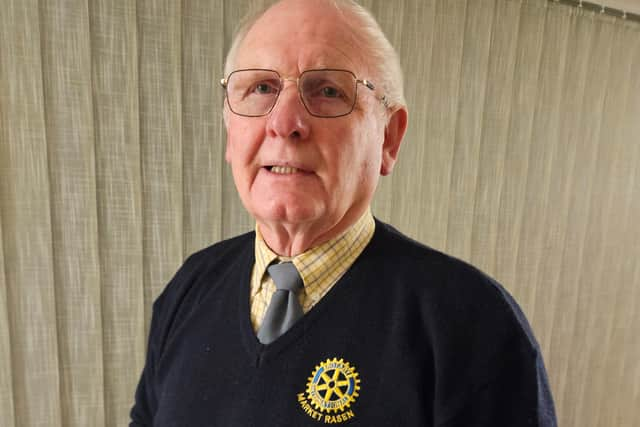

Stuart publicly recognised the use of contributions made by the Late Alan Frankish, The Late Rex Russell and Pat Frankish from a document on the history of Caistor Hospital, dated 1993. Also some quotations used relate to reports from the Stamford Mercury.
Caistor Hospital
Founded in 1802 by William Dixon of Holton le Moor and was originally known as a House of Industry. The guiding principles of the building were :- “This Asylum “be termed as a School of Industry and Charity inferior to few in the Kingdom”.The principle aims were to provide for the unclean poor - Cleanliness , - for the drunken poor Sobriety - , for the idle poor, Industry - to the wicked poor, piety - and for the ignorant poor – Instruction.1802-1836 management of the building was by The Society of industry under the leadership of William Dixon
To provide for better relief of the poor and saving the parish money with the clearly stated aims established by “ Constitutional means” to better the conditions of the Poor, by properly training up the children and adults to more settled habits of industry, economy, and piety; liberally to provide for the aged and impotent; truly alleviate the heavy burdens on parishes; humbly to solicit the aims of the Charitable….persons and prudently to appropriate them to the most profitable purposes; as a means to making mankind more content and happy. In advancing these aims the Caistor Parish was enlarged with about 20 other parishes and under Mr Gilberts Act the building commenced on moorland on Caistor Common donated by the Freemen of Caistor. £2500 had been raised for construction.
Gradually from 1802 people were moved in,24 adults 18 children who were taught to spin wool and knit.The building was isolated from the town and governed by the Guardians of the Poor and rules and regulations were enforced by a Governor and Matron. Morals of the poor seem to have been closely monitored.It was not until the Enclosures Act around 1814 that farms and roads on the moor began to appear, thereby decreasing the isolation of the site.It should be noted that the Society of Industry was not just confined to the Caistor House on the Moor, They were involved in trying to improve the lot of those who were poor in other parts of the Community.
By 1814, 51 parishes were spread over North Lincs and each parish was responsible for relief of its own poor through the Offices of Overseers of the Poor. The cost of keeping a pauper was 3 shillings a week. Inmates had to work but a proportion of their earnings was paid the Parish from whence they came.The object of course was to rehabilitate them into good industrious, sober and orderly members of society and eventually not continue as a financial burden. How successful this was is open to debate. Sunday school teachers were charged to “tame the ferocity of their unsubdued passions, repress their rudeness and eliminate the demoralising obscenity of their language”! Self reliance and mutual support were the objectives
Over the early years it was generally reported in the Stamford Mercury that the Institution was ‘well managed’
However the place was not without problems and a report of the Guardians Committee in 1824 clearly highlights concerns about women who were illegitimately pregnant and duly ordered that no such women shall be admitted to the House of Industry.In 1836 one Joseph Cammack from Bishop Norton absconded leaving a wife and children chargeable to the Parish of BN. A reward of one guinea was offered for his apprehension. Eventually more criticism of the management ensued from Sir Culling Eardley Smith Nettleton in relation to the way in which lunatics(term of the time) were looked after. He did not believe that the Master of the House , although a good and well intention man, had the relevant experience in dealing with 3 lunatic women. Representation was made to Edwin Chadwick Secretary of State to the Poor Law. His concern was that he had witnessed female Lunatics tethered by collar and chain to a bedstead with little or no help.
1834 saw the Poor Law passed resulting in major reorganisation by grouping parishes compulsory together into Poor Law Unions. The outcome was ,after much deliberation by the Guardians of the House of Industry, following a meeting of the great and the good at the Red Lion in Caistor, was the eventual formation in 1836 of the Caistor Poor Law Union embracing 76 parishes including Grimsby and Market Rasen (formerly 52 )
From 1836 to 1937
It was believed that the New poor Law had lifted whole counties from pauper bondage to that of independent labourers . This may have been true to some extent but it was largely wishful thinking. As far as the Caistor Union was concerned, it appears that much went on as before. The master Robert Witham continued in post until 1856. However, it is worth noting that the pauper children who did receive some education under the old system continued to receive education under the new. Indeed, only pauper children were compelled to attend school and for many years afterwards. School Teachers were employed to instruct in the 3 Rs. Salary £25 per annum for a male and £15 for a female.
1856 the site could accommodate 260 inmates and by 1861 detached fever wards were in existence. A new school and masters House was built cost of £350 and in 1866 a chapel was built for a cost of £340. Following the opening the inmates were treated to afternoon tea. We can see that the whole site was becoming very prominent in the community.Between 1831 and 1911 the Union population fell ( formation of the Grimsby Union after 1891 )and consequently the numbers reduced leaving space for boarders from other Unions.By 1937 the institution had a new role, and Kellys Directory reported that “ The former Institution was now certified for the reception of mental defectives with accommodation for 120 patients.
From 1937 to 1974
In May 1937 all patients were temporarily moved to Holbeach, to allow for major redevelopment of the Caistor site which included a new Boiler House with steam heating and a hot water plant, new laundry facilities, new machinery and refurbished kitchen facilities. Central Heating was installed throughout the whole institution.
By 1938 it was officially reopened with a Board of control certificate. 20 male patients under 16 and 110 female patients over 16 years.
Caistor formed part of the Lincolnshire Joint Board for Mentally Defectives. HQ was at Harmston.Much good work was done under the supervision of the medical Superintendent , Dr Laverty, with his friendly and considerate approach to forming good relationships and progressive improvement for all inmates.Employment was found where appropriate within the Institution service departments. An occupational therapy unit was formed with rug making, knitting , embroidery, basket making etc. In some circumstances the more able inmates were found employment in the local community and for instance patients being employed by Mr and Mrs Sparrow in South Street, Caistor and Mr Jackson the Dentist and likely several more.
The outbreak of war in 1939 brought some restriction to large scale progress in developing improvements for the patients and only limited maintenance was achieved. Life generally, continued in a pleasant way. Major change came in 1948 with the passing of the National Health Act and for the first time the Institution became a Hospital under the terms of the Act. From this point the hospital was expanded in terms of the wider interpretation of care and rehabilitation also in the physical development of buildings. In 1953 a 40 bed single storey unit was built for low grade male children, together with 2 pairs of staff houses.
1963 saw the development of a new Recreation Hall under the auspices of the Sheffield Regional Hospital Board and this building remained in constant use for Social events, Dances, Concerts Film Shows Fashion Shows etc etc. From 1960 finance was available to carry out considerable upgrading and additions of facilities, sun verandas, internal/external decorations.For the first time since 1937 15 full adult males were admitted to the hospital in 1966. This no doubt placed a greater responsibility on the Staff in terms of social interaction.
1971 and 1974 saw the building of further specialist units for older infirm patients and considerable help was given to patients with the addition of a therapy pool in 1974. Also in this year a Domestic Social Training Unit was provided to help those who may be eventually discharged or at least provide them with some skills for greater independence.Further improvements were aimed at improving the quality of the lives of inmates
In 1956 The League of Friends was established, the purpose of which was to co-ordinate community support with the Hospital. Caistor Hospital has always been considered a major part of Caistor Life and many Organisations have been very active and supportive in providing entertainment, donating goods and services all aimed at improving the lives of those who lived there.The continuing emphasis was about improving the lives of the patients to make them, as far as possible, able to function as reasonably normal citizens. It is fair to say that the original vision of the Founder , William Dixon in 1803 was by and large, achieved “ To make mankind more content and happy.”.
The 1971 Education Act saw the introduction of a dedicated school at the Hospital and all the children under 16 years received some form of education. No more children under 7years were admitted for long- or short-term care.Major changes in Local Government in the 1970s and 80s led to further changes about how care should be provided and new initiatives, this led to more emphasis on care in the Community and it was considered that the current situation was not necessarily the right places for the mentally disabled.Eventually more people were moved out to Social Service hostels in Brigg and Grimsby and the population f the hospital went into decline.
In 1984 the way in which the Hospital was managed, changed dramatically. Mr Frankish , The Hospital Secretary for 46 years retired, and the overall management passed from Lincolnshire to Grimsby Health. This move sounded the death nell for Caistor Hospital with the gradual relocation of residents to other areas, the Hospital was scheduled for closure.Patients were swapped about to other areas under various projects, halfway houses, short stay units, joint projects with MENCAP in Cleethorpes, Private sector projects for small scale care homes.To support these moves a new Day Services Centre was built in Cromwell Road Grimsby. There are of course arguments as to whether it was the right thing to do as most of the patients were very happy in the Caistor environment.
Finally in 1990 after 190 years’ service, the Hospital closed and sadly, Caistor lost a major Community Asset with the accompanying loss of substantial employment opportunities. It should be noted that no one was resettled in Caistor Town.
In 1966, our speaker, Stuart, an employee of the then Caistor Rural District Council, under a new Government initiative, was invited by the Clerk of Caistor RDC George Barr MBE , to set up A Service By Youth Project for Caistor. The aim was to raise funds and provide practical help to those in the Community who were in need, particularly the disabled or elderly. One of the major achievements of Service By Youth in conjunction with the Youth Club was to completely decorate a newly acquired (ex army hut ) for recreational /occupational health use at Caistor Hospital. This was very much appreciated by the Hospital and the League of Friends and we really enjoyed doing it.