
Boston students share experience of Auschwitz as part of Holocaust educational project
With a new academic year under way, we return to an interview we carried out ahead of the summer break with two students at a school in Boston who had taken part in a remarkable educational project relating to Auschwitz.
Josh Bursnell and Bradley Petley visited the Nazi concentration and extermination facility as Year 13 students at Boston Grammar School through the Lessons from Auschwitz Project.
Run by the Holocaust Educational Trust, the project offers post-16 learners across England, Scotland and Wales the chance to learn about the Holocaust and consider its relevance for today.
As part of this, students experience the Auschwitz-Birkenau Memorial and Museum through a one-day visit to Poland.
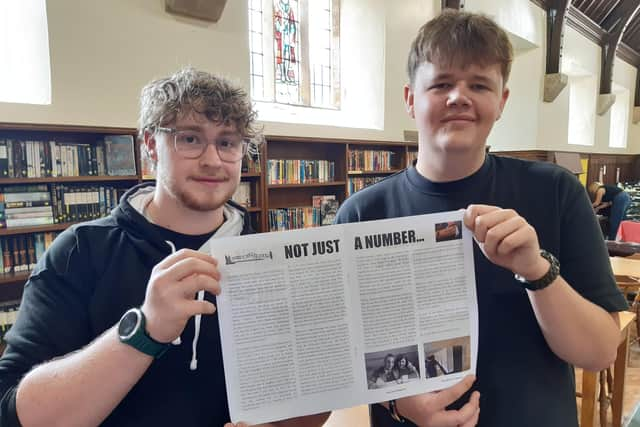

Speaking to the Standard, Josh, formerly of William Lovell CofE Academy, in Stickney, said he has had a long-standing interest in that era of history.
“It’s not that long ago that such a big event happened, less than a century,” he said.
Bradley, a former pupil at Boston’s Haven High Academy, decided to join Josh on the project, as he has aspirations of becoming a teacher and thought the ‘first-hand experience’ of that chapter in history may help him in the future.
Asked about their impressions of Auschwitz, they both used the word ‘eerie’.
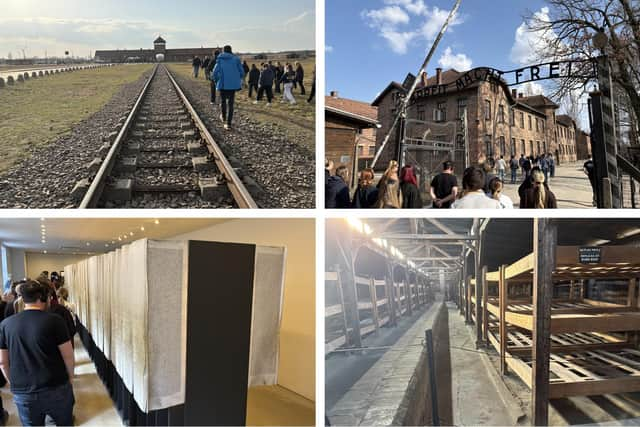
Bradley said: “It was upsetting to know that the paths that we were walking on were the same paths people unfortunately would have walked on there.”
Josh said he found it ‘difficult to put into words’.
“I'm normally quite a chatty person,” he said. “When I was there, I was silent. I couldn’t find any words.”
The final part of the project was to present the information they had gathered through the project to others. This Josh and Bradley did through the school’s newspaper.
In this, they wrote of how learning about case studies – individuals among the millions killed in the Holocaust – had helped them towards a more complete understanding of the atrocity. Such case studies, they included in their report.
“When we went to Auschwitz, we realised the importance of remembering the Holocaust, not just the statistics, but in remembering those who died in the Holocaust,” they wrote. “And how each of the victims in the Holocaust was someone’s child, brother, mother, father, friend etc.
“When we learn about them and when we share what we have learned, we can make sure that they are remembered as a person not a number.”