
Civic Trust installs eighth blue plaque town marking historic 'Roaring Bridge'

Sleaford Civic Trust has installed an eighth blue plaque in its continuing series marking historic locations in the town.
The plaque is now in place near to the entrance to Roaring Bridge Lane, a cobbled path which links Watergate and Westgate next to Holton Sleaford Independent School.
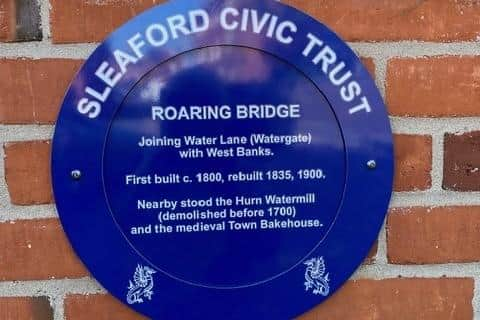

Historian Dr Simon Pawley, who is involved with the project, has written a short history about this area.
He explains: “It’s difficult now to imagine what Watergate and West Banks looked like before the River Slea was bridged at this point but the first bridge, ‘Roaring Bridge’, was only constructed in around 1800.
"Before that, Watergate was a dead end. It took you down to the river but there was no way across to The Tofts (West Banks) beyond. The Tofts were just a series of low-lying fenland closes, mainly used for pasture and probably flooded regularly by the river to their north. Only when the modern streets off West Banks were developed in the years between 1845 and the First World War was the river put into the deep culvert that we see today, in an attempt to control it.”
Dr Pawley says the name Watergate (or Water Lane) is comparatively recent. On the north side of Roaring Bridge Lane, where Riversdale Clinic now stands, was the site of Sleaford’s medieval Common or Town Bakehouse and for centuries the road was known as Bakehouse Lane.
Until it disappeared in the middle of the seventeenth century, the Common Bakehouse was where the bakers and other inhabitants of the town were supposed to come in order to use its large communal oven for baking bread. Because of the risk of fires, bakehouses were often placed away from other buildings and (as here) siting it close to a river was a sensible precaution.
Dr Pawley said, like milling grain, common bakehouses were a monopoly run by the manor. If you lived in Sleaford, you were supposed to bake only at the common bakehouse and you could be fined for breaking the rules.
“Behind the back of the old fire station building on the south side of Watergate was the Hurn Mill, one of Sleaford’s five medieval watermills and one of two that stood within yards of each other in the centre of Sleaford,” he said.
Its companion, the Malt Mill or Town Mill, is commemorated by another Civic Trust blue plaque on Jennings bookmakers, opposite the entrance to Costa Coffee. A “hurn” is a bend in a road or river, like the one the River Slea takes at this point.
Even in the 1550s the Hurn Mill was described as “in great ruin and decay” and it disappeared completely at some time between the two surveys of Sleaford done in 1627 and 1692.
The next two Blue Plaques are already in the process of being produced and it is hoped that they will be in place during the next few months, as the 10th one will need Listed Building Consent.