
Behind the scenes at RAF Coningsby centre that controls county's airspace
Leaders have given a revealing glimpse behind the scenes at a centre, based at RAF Coningsby, that manages the flow of all aircraft in and out of Lincolnshire.
The county’s airspace is busy at all times and keeping it safe for civilian and military aircraft is the job of the Lincolnshire Terminal Air Traffic Control Centre (TATCC).
With four flying stations at Barkston Heath, Coningsby, Cranwell and Waddington, Lincolnshire is still very much an RAF county. And because RAF Coningsby is a 24/7 station, there are always qualified controllers on duty in the tower.
A team that is more than 70-strong is led by Squadron Leader Andrea Jackson, who said: “The airspace is busy and complex. There are four busy flying stations, all within 15 miles of each other.

"Daily, all of them deliver operational output and critical flying training, conduct display flying and act as bases for multinational exercises. This is in addition to the general aircraft traffic, and the airborne emergency services.”
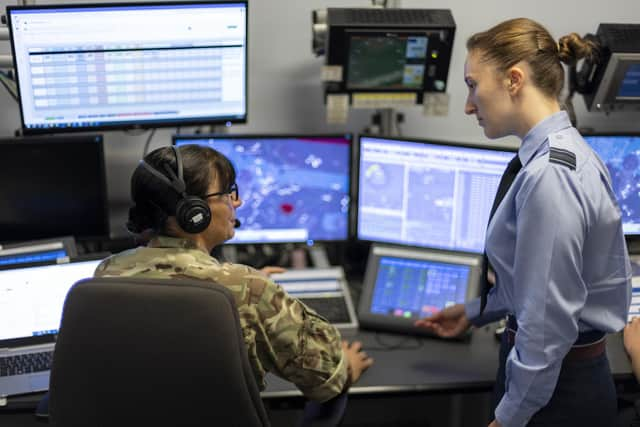
Some of the many responsibilities of the squadron’s air and space operations specialists are the final checks of an aircraft before landing, controlling vehicle movements on the airfield, and updating air traffic systems with flight critical information.
Squadron Leader Jackson said: “The controllers manage the airspace, but our specialists make sure the centre has up-to-date critical information, and that RAF Coningsby has a safe operating environment on the ground.”
Wade Tear is an air and space operations specialist and joined the RAF in 2002. He said: “No two days are ever the same here at Coningsby and I would describe it as ‘good busy’.
"There’s always something going on, with new challenges to face and tasks to complete which assist in the station’s flying output.
"You could be called up to assist with an aircraft emergency or the launch of our QRA (quick reaction alert) Typhoons at the flick of a switch”.
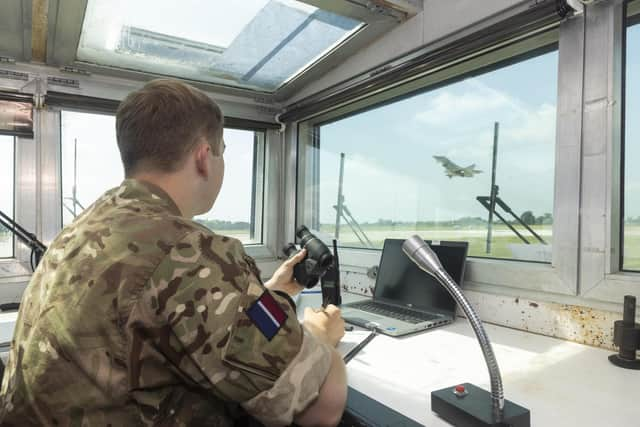
All four stations have visual control rooms, where controllers can see aircraft arriving, landing and departing from their airfields.
But the RAF Coningsby centre’s operations room is the nerve centre for all the stations in Lincolnshire’s airspace. On their screens, the controllers can see and direct aircraft up to 40 miles away. In 2024, the centre provided air traffic services to about 60,000 aircraft.
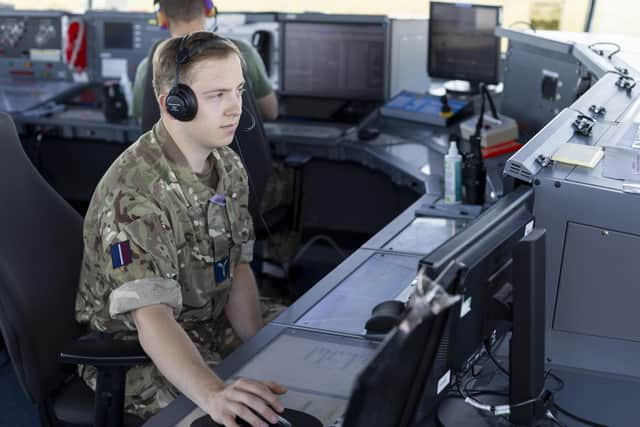
Squadron Leader Jackson added: “It is a challenging job because, in their minds, controllers must reinterpret a two-dimensional image on the screen in front of them into a three-dimensional image.
"They need to rapidly assimilate multiple inputs safely and effectively, requiring mental agility. And then there’s communication. Controllers must understand their aircraft, routing and restrictions, while effectively communicating with correct wording and maintaining a safe service.”
At RAF Coningsby alone, there are five fast jet Typhoon squadrons, and the piston-engine Battle of Britain Memorial Flight. These aircraft fly and manoeuvre at completely different speeds, but they take off and land at the same airfield.
At RAF Waddington, there are fast jet and multi-engine aircraft, the Red Arrows team and also Protector, which is a remotely piloted aircraft.
The commanding officer of the operations support wing, of which air traffic control is a part, said: “Air safety is our top priority. We must make sure that everyone who uses Lincolnshire’s airspace is deconflicted and has enough room to do what they need to do safely.
"It sounds simple, but you need qualified personnel who take their roles extremely seriously.”
She concluded: “The team in air traffic have an extremely complex and challenging role in one of the UK’s busiest areas of airspace.
"All personnel are highly skilled and form an integral part of keeping our skies and aircraft safe 24/7.”
RAF Coningsby is home to two frontline, combat-ready squadrons and is the training station for Typhoon pilots.
The base is also one of two RAF QRA stations which protect UK airspace. Almost 3,000 service personnel, civil servants and contractors work there.